} -->

Tudor Mince Pies (1591) – For Pyes of Mutton or Beefe from A Book of Cookrye

For Pyes of Mutton or Beefe (A Book of Cookrye, 1591)

Originally published: December 31, 2020 · Updated: November 15, 2025

16th-century mince pies filled with beef, suet, dried fruits, and spices

🥕 Dietary Notes: Contains gluten, beef, and dried fruit. Suet may be replaced with vegetable shortening for a vegetarian-friendly option (texture and flavor will differ from period practice).

Kitchen Notes: For SCA feasts, I always post an ingredient-based menu on the kitchen door and tables, and I am happy to accommodate dietary needs with advance notice. Medieval dishes often contain ingredients modern diners may not expect, so clear labeling is essential.

A Note on Historical “Mincemeat”

Today, “mincemeat” often refers to a sweet mixture of fruit, spices, and sometimes spirits—but from the Middle Ages through the early modern period, mince pies always contained meat. The traditional mixture blended minced beef, mutton, or veal with suet, dried fruit, warm spices, and sometimes saffron.

These were hearty, savory-sweet hand pies served throughout the winter and were far closer to a spiced meat pastry than a modern dessert.

Original Recipe (1591)

For Pyes of Mutton or Beefe.
Shred your meat and Suet togither fine, season it with cloves, mace, Pepper, and same Saffron, great Raisins, Corance and prunes, and so put it into your Pyes.
~ A Book of Cookrye Very Necessary..., 1591

Modern English

Shred your meat and suet together fine. Season with clove, mace, pepper, and a little saffron. Add large raisins, currants, and chopped prunes, and place the mixture into your pies.

A Quick Story About Mincemeat & Misunderstandings

At one SCA event where I served these pies, a guest came into the kitchen distraught after eating a mince pie “with meat in it.” She had assumed they were vegetarian, not realizing that historical mince pies always contain meat. The menu—with a full ingredient list—was posted at the kitchen door and on the tables, but modern expectations can surprise people.

This experience reinforced why I am meticulous about posting detailed ingredient-based menus and why I encourage diners to share dietary needs in advance. I can always accommodate those needs when I know about them, and it helps everyone enjoy feast day without worry.

Why Medieval Cooks Mixed Meat, Fruit, and Spices

To a modern palate, combining beef with raisins and saffron may seem unusual, but in the 15th and 16th centuries this combination reflected the height of good cookery. Medieval recipes often balanced warm and cold humors using meat, fruit, and spices to keep the body in proper “temperament.”

Dried fruits brought sweetness and moisture; spices like mace, clove, and pepper added warmth and helped “correct” the perceived coldness or dampness of certain foods. Saffron contributed both color and a sense of luxury. A pie like this was not a random flavor mashup, but a carefully considered dish grounded in medieval food philosophy.

Mince Pies at the Medieval Table

Pies were central to medieval and Tudor feasts. A well-made pie demonstrated the cook’s skill, the host’s wealth, and the kitchen’s organization. Small, hand-sized pies like these were easy to portion out in a noisy hall, could be served hot, and traveled well on trenchers or small plates.

Mince pies appear in banquet menus, civic feasts, and household accounts as part of winter and holiday fare. Rich with meat, fat, fruit, and spice, they signaled generosity as much as good taste.

Historical Background

In medieval and Tudor England, mince pies were part of a long tradition of mixing meat with fruit and warm spices. This blend of savory and sweet flavors created a rich, festive pie that was especially popular during winter months and holidays. The dried fruit added subtle sweetness, the suet added richness, and the spices—clove, mace, pepper, and saffron—brought warmth and luxury.

By the 18th and 19th centuries, mince pies evolved into the sweet-only versions we know today, but in 1591, they were still very much a savory meat dish with a delicate sweet note.

How Mince Pies Changed Over Time

In the 16th century, mince pies were hearty, savory dishes that happened to include fruit. Over the 17th century, the amount of sugar and dried fruit increased, and the spice blends became more elaborate. By the 18th and 19th centuries, many “mincemeat” recipes had lost the meat entirely, relying instead on suet, fruit, sugar, and alcohol.

This 1591 recipe belongs to that earlier, meat-forward tradition. If your only experience of mince pies involves modern Christmas desserts, these will be a completely different—and delightfully historical—experience.

What These Pies Taste Like

These pies are savory first, with gentle sweetness from the dried fruits. The spices and saffron provide warmth and fragrance without overpowering the meat. They’re rich, filling, and wonderfully medieval—best enjoyed warm, and very much a hand pie rather than a dessert.

Why Saffron?

Saffron was one of the most prized spices in Tudor England. It added not only a golden hue, but also warmth and gentle floral notes. Its presence in a pie signaled celebration, hospitality, and expense—saffron was never used casually. A pinch in the filling is a small nod to the luxury this recipe would have represented on a 16th-century table.

What Suet Adds to the Recipe

Suet is the hard, clean fat from around the kidneys of cattle or sheep. It has a higher melting point than butter, which gives medieval pies their characteristic light, crisp bite and keeps the filling rich without becoming greasy.

Rendered suet (tallow) also acted as a preservative fat in winter cookery. When mixed with dried fruit and spices, it produced a filling that stayed good far longer than fresh meat alone. For cooks working with cool pantries and open hearths, this made mince pies both festive and practical.

How to Serve These Mincemeat Pies

These pies are best served warm from the oven and make excellent hand food for feasts, holiday tables, potlucks, or outdoor events. Their rich filling and small size make them ideal for the first or second course of an SCA feast.

If you want to stay close to period service, consider pairing them with:

  • a hot spiced drink, ale, or hippocras
  • a simple salad of herbs or “sallet” greens
  • a pottage or broth as a preceding course

Cook’s Notes

These little pies surprised me with how comforting and deeply flavorful they were. The saffron lifts the filling, the prunes add richness, and the suet gives the mixture the perfect texture. They remind me of other European holiday meat pastries, but with a distinctly medieval soul. If you enjoy this recipe, it pairs beautifully with other late 16th-century dishes and makes a fine addition to a winter or Christmas-themed board.

How to Make Violet Syrup — Medieval to Modern Color-Changing Spring Cordial

Green, Magenta and Lavender Violet Syrup
Originally published 5/15/2015. Updated 11/15/2025.

Violet syrup is one of the oldest and loveliest floral syrups found in European, Mediterranean, and Middle Eastern culinary traditions. Used historically to ease coughs, cool fevers, soothe sore throats, and delight the eye, violet syrup has remained surprisingly unchanged across the centuries.

To make the best syrup, choose the deepest-colored sweet violets you can find. The infusion pulls its color directly from the petals—so the darker the bloom, the more vivid your syrup will be. Most North American violets lack fragrance, and that’s perfectly fine; the flavor comes from the infusion itself.

And yes—it really does change color! Add lemon juice and it turns a brilliant magenta. Add rosewater or another alkaline ingredient and it becomes green. Historically, violets were even used as a natural pH test long before litmus paper was invented.

Butter’d French Beans (1660) — Robert May’s Table Greens for a Holiday Feast

HomeTudor & Stuart Thanksgiving Series › Butter’d French Beans (1660)

Butter’d French Beans (1660) — Robert May’s Table Greens for a Holiday Feast

Part of the Tudor & Stuart Thanksgiving Series — exploring how early modern English cooks transformed simple vegetables into elegant side dishes fit for the season’s most abundant table.

Dutch-style still life of autumn fruits and vegetables representing the Tudor & Stuart Thanksgiving table.
Still Life of Autumn Fruits and Vegetables — shared image for the Tudor & Stuart Thanksgiving Series, evoking abundance and the early-modern feast.

A Gentle Dish for the Early-Modern Table

By the mid-17th century, “French beans” — the New World haricot — had become a fashionable vegetable in England. Robert May includes several recipes for them in The Accomplisht Cook (1660), treating them tenderly with butter, vinegar, and spice. They offer a luminous green note amid the roasts, puddings, pies, and rich sauces of the season — a perfect complement to a modern Thanksgiving table inspired by early modern English cookery.

Historical Context

New World Origins: Haricot beans (Phaseolus vulgaris) are native to Central and South America. Long before European contact, Indigenous farmers cultivated dozens of varieties—green beans, kidney beans, and shelling beans—across Mesoamerica and the Andes. They formed part of the “Three Sisters” agricultural system alongside maize and squash.

Arrival in Europe: Spanish explorers brought these New World beans to Europe in the early 1500s. By the 1530s they appear in Mediterranean gardens; by the 1550s they were fashionable in Italy and France, where they were prized for their thin, edible pods. England, following French horticultural fashion, adopted them slightly later—thus the English name “French beans.”

Adoption in England: By the late 1500s, green beans were grown in English kitchen gardens, though still considered something of an imported delicacy. Herbalists such as John Gerard (1597) describe “the French bean which cometh from beyond the seas,” distinguishing it from the older Old World broad bean (Vicia faba). These slender beans were more tender, easier to cook, and well suited to the new culinary trend of lightly prepared vegetables.

Why They Appear in May (1660): By Robert May’s time, French beans had become a regular feature in elite kitchens. His recipe aligns with the era’s preference for simple treatments—boiling, buttering, and seasoning—allowing the vegetable’s natural color and delicacy to shine. The touch of vinegar and nutmeg reflects early-modern taste for balancing “cold and moist” foods with warming spices.

From New World to Tudor Thanksgiving: The journey of the French bean—from Indigenous agriculture to Spanish ships, to French gardens, to English cookbooks—mirrors the broader Columbian Exchange that reshaped European foodways. Serving this dish at a modern Thanksgiving connects the contemporary holiday table with the very ingredients that transformed 17th-century English cooking.

Original Recipe 

Robert May, The Accomplisht Cook (London: 1660), p. 204.
Public link to the recipe on Archive.org

To stew French Beans.
Take your French beans and string them, then seeth them well in fair water; when they are tender, put them into a pipkin with some sweet butter, a little vinegar, pepper, and salt; and shake them well together. Serve them hot, with grated nutmeg cast upon them.

Barberry Sauce for Roast Meats (1660) — A Tudor & Stuart Alternative to Cranberries

Dutch-style still life of autumn fruits and vegetables representing the Tudor & Stuart Thanksgiving table.
Still Life of Autumn Fruits and Vegetables — shared image for the Tudor & Stuart Thanksgiving Series, evoking abundance and the early-modern feast.

HomeTudor & Stuart Thanksgiving Series › Barberry Sauce for Roast Meats (1660)

Barberry Sauce for Roast Meats (1660) — A Tudor & Stuart Alternative to Cranberries

Part of the Tudor & Stuart Thanksgiving Series — exploring how early modern English cooks used tart, jewel-red fruits like barberries to brighten rich feasts in much the same way we use cranberry sauce today.

A Sharp, Scarlet Counterpoint to Roast Meat

Long before cranberries became iconic on American holiday tables, English cooks were using barberries to do a very similar job. These tiny, vivid red berries — the fruit of the shrub Berberis vulgaris — appear in 16th- and 17th-century English recipes as garnishes, pickles, and sharp, “cooling” sauces for goose, pig, pork, and rich pies.

In The Accomplisht Cook (1660), Robert May scatters barberries through pies and dressings, and suggests them in sauces for goose and other roasted fowl. Their bright acidity and ruby colour made them a perfect foil for fatty meats — a role cranberries would come to play later in colonial New England.

Barberries, Cranberries, and the Thanksgiving Table

Barberries in England: Barberries are native to Europe and western Asia. In early modern England they were valued both as a medicine and a culinary ingredient, especially for their sharp taste and striking colour. They were used in pickles, preserves, sauces, and as garnishes on rich dishes, and were common enough to appear repeatedly in British recipe books and household manuscripts.

Cranberries in North America: Cranberries (Vaccinium macrocarpon) are native to North America. Indigenous peoples in New England and the Canadian Maritimes harvested them for food, dye, and medicine. Seventeenth-century English accounts of New England describe “craneberries” being eaten with meat and as part of pemmican-like preparations.

Parallel Uses, Different Histories: While there is no surviving English recipe that says “use cranberries where you would use barberries,” the two fruits occupy very similar roles:

  • Both are small, tart, scarlet berries.
  • Both were served with rich meats as a sharp, refreshing contrast.
  • Both appear in sauces, relishes, and preserves.

In England, barberries remain the canonical choice in the 17th century; in colonial New England, cranberries fill the local niche. For modern historical cooks in North America, cranberries can be a practical stand-in when barberries are unavailable — as long as we are clear that the substitution is modern, not Tudor or Stuart.

Period Sources: Barberries in Robert May’s Kitchen

Sauce for a Goose — Robert May, The Accomplisht Cook (1660)

The following comes from May’s “Sauce for a stubble or fat Goose”, which gives two forms. The second explicitly calls for barberries in a rich apple-based sauce.

Source: Robert May, The Accomplisht Cook (London, 1660), “Sauce for a stubble or fat Goose.” The full text is available via Project Gutenberg and early modern facsimiles.

Sauce for a stubble or fat Goose.
1. The Goose being scalded, drawn, and trust, put a handful of salt in the belly of it, roast it, and make sauce with sowr apples slic’t, and boil’d in beer all to mash, then put to it sugar and beaten butter. Sometime for veriety add barberries and the gravy of the fowl.

2. Roast sowr apples or pippins, strain them, and put to them vinegar, sugar, gravy, barberries, grated bread, beaten cinamon, mustard, and boil’d onions strained and put to it.

To Pickle Barberries Red — Robert May, The Accomplisht Cook (1660)

May also gives directions for pickling barberries, which provide the preserved fruit used in sauces throughout the year.

Source: Robert May, The Accomplisht Cook (London, 1660), section on pickles and preserves (often titled “To pickle Grapes, Gooseberries, Barberries, red and white Currans” and related entries).

To Pickle Barberries Red.
When your Barbaries are picked from the leaves in clusters, about Michaelmas, or when they are ripe, let your water boyl, and give them a half a dozen walms; let your pickle be white-wine and vinegar, not too sharp, so put them up for your use.

Sweet Potatoes Three Ways (1660–1670) — May & Woolley at the Early-Modern Table

HomeTudor & Stuart Thanksgiving Series › Sweet Potatoes Three Ways (1660–1670)

Sweet Potatoes Three Ways (1660–1670) — Robert May & Hannah Woolley

Part of the Tudor & Stuart Thanksgiving Series — exploring how early modern English cooks transformed New World ingredients into elegant, comforting, and festive dishes fit for the season’s most abundant table.

Dutch-style still life of autumn fruits and vegetables representing the Tudor & Stuart Thanksgiving table.
Still Life of Autumn Fruits and Vegetables — shared image for the Tudor & Stuart Thanksgiving Series, evoking abundance and the early-modern feast.

A New World Root, Transformed by English Cooks

Sweet potatoes — known in 17th-century England as “Spanish Potatoes” — arrived through Spanish trade routes in the early 1500s. Originating in Central and South America, Ipomoea batatas traveled across the Atlantic decades before the white potato and quickly became associated with luxury, warmth, and even medicinal virtues.

By the time of Robert May and Hannah Woolley, sweet potatoes were considered both a delicacy and a curiosity: sweet, moist, filling, and ideal for combining with sugar, sack, spices, and butter. These dishes, though rarely seen on modern tables, shimmer with warmth and holiday resonance — a perfect trio for a historically inspired Thanksgiving feast.

Expanded Historical Notes: Sweet Potatoes in Early Modern England

New World Origins: Sweet potatoes were cultivated by Indigenous peoples across the Caribbean, Central America, and the Andes long before European contact. Their sweetness, vivid color, and adaptability made them an ideal export crop during the Age of Exploration.

Arrival via Spain: Spanish ships carried sweet potatoes to Europe in the early 1500s; they quickly spread through Mediterranean trade networks and then northward. They reached England by the 1520s–1530s, where they were sold as exotic novelties — often linked to aphrodisiac qualities and “warming” humoral properties.

“Spanish Potatoes” vs. “Potatoes”: Early modern English texts differentiate between:

  • Spanish Potatoes — sweet potatoes
  • Potatoes — the newly introduced white/Irish potato
May uses both terms; Woolley uses both interchangeably depending on the edition. In culinary practice, the sweet potato is the one combined with sugar, spices, and citrus.

Humoral Medicine: Sweet potatoes were classed as “hot and moist,” nourishing and gentle on the stomach. Combined with warming spices (cinnamon, nutmeg), sugar, or sack (fortified wine), they were thought to strengthen the body in cold months — making them an ideal winter dish.

Culinary Meaning: These recipes show how New World ingredients integrated into English feasting culture — sweet, rich, buttery, and festive. Serving them today forms a bridge between the Columbian Exchange and the modern Thanksgiving table.

Period Recipes (Three Ways)

1. Robert May — The Accomplisht Cook (1660)

“To butter Potatoes.”
From The Accomplisht Cook, Book V, p. 225 (1660).
Public link to May’s recipe

To butter Potatoes.
Take Potatoes and roast them, then peel them and slice them; then strew sugar, cinnamon, and salt on them, and put in a piece of butter; then toss them up, and serve them hot.

2. Hannah Woolley — The Queen-Like Closet (1670)

“To Preserve Potatoes.”
Book I, “To Preserve Potatoes.”
Public link to Woolley

To Preserve Potatoes.
Take your Potatoes, and slice them very thin, then boil them in water till they be tender; then take them up, and dry them, and boil Sugar and water to a thickness; then put in your Potatoes, with a little Rosewater, and so keep them for your use.

3. Woolley Tradition — Potato Pottage (17th c.)

Referenced across multiple household manuals of the 1650s–1670s; a warming household dish.

Potato Pottage.
Boil your Potatoes in fair water or broth till they be tender; then bruise them, and put to them strong broth, a little grated bread, sweet butter, and such herbs as you like; season it with Salt, and so serve it well stewed.

Pumpion Pie (1658 & 1670) — The Earliest English Pumpkin Pie from The Compleat Cook and The Queen-Like Closet

England’s earliest spiced pumpkin pies: 1658 & 1670 English “pumpion” pies layered with apples or scented with sack and rosewater—two period versions, two modern bakes.

Pumpion Pie (1658 & 1670) — The Compleat Cook & The Queen-Like Closet

HomeTudor & Stuart Thanksgiving Series › Pumpion Pie (1658 & 1670)

Part of the Tudor & Stuart Thanksgiving Series — Early modern English cooks balanced spice, fruit, and rich sauces to delight feast guests. In that spirit, we imagine how 17th-century dishes—roasts, puddings, and pies—might grace today’s Thanksgiving table with historical flavor and good cheer.

Dutch-style still life of autumn fruits and vegetables representing the Tudor & Stuart Thanksgiving table.

A Pie of Pumpion and Apple — England’s First Pumpkin Pies

By the mid-1600s, New World “pumpions” (pumpkins) found a home in English kitchens. Two of the earliest printed examples—The Compleat Cook (1658) and Hannah Woolley’s The Queen-Like Closet (1670)—reveal different approaches: one layers herbed pumpkin fritters with sliced apples and currants, finished with a wine-egg caudle; the other stews and mashes the pumpkin, perfumes it with rosewater and sack, and glazes it with a sweet caudle. Together, they prefigure the later Anglo-American pumpkin custard pie while retaining a distinctly Restoration palate.

Historical Context: The Journey of the Pumpkin

From the New World to the Old: Pumpkins (Cucurbita pepo) are among the oldest cultivated crops in the Americas, domesticated in Mexico around 7000–5500 BCE. By the 15th century they were a staple from South America to New England. Spanish and Portuguese explorers carried seeds home in the early 1500s, where the “Indian gourd” quickly took root in Iberian and Italian gardens.

Arrival in England: The word pompion (later spelled pumpion or pumpkin) entered English by 1548, from French pompon and ultimately Latin peponem, “melon.” William Turner’s Herbal (1551–68) lists the pompion among familiar garden plants, and John Gerard’s Herbal (1597) describes “the great round pompion,” judging it “cold and moist in the second degree.” English cooks viewed it as a vegetable requiring the balancing warmth of spice, wine, and butter.

Early English Recipes: By the mid-1600s, the pumpkin had moved from curiosity to kitchen. The herbed, apple-layered pie in The Compleat Cook (1658) and Hannah Woolley’s sweeter rosewater version in The Queen-Like Closet (1670) mark its first recorded uses in English cookery. Both reflect a transitional taste—part vegetable fritter, part custard pie—infused with the season’s abundance of spice.

Across the Atlantic Again: English colonists in New England found pumpkins thriving in Indigenous fields and adopted them eagerly. By the late 17th century, colonial cooks abandoned herbs and apples for smooth spiced custards, giving rise to the pumpkin pie of early American tradition, immortalized in Amelia Simmons’s American Cookery (1796).

DateEventLocation
~7000 BCEPumpkins domesticatedMesoamerica
Early 1500sIntroduced to Europe by Spanish explorersIberia
1536Described in Mattioli’s CommentariiItaly
1548First English record of “pompion”England
1597Gerard’s Herbal notes “great round pompion”England
1658The Compleat Cook publishes “Pumpion Pie”London
1670Hannah Woolley’s Queen-Like ClosetLondon
1796Amelia Simmons’s American CookeryUnited States

Humoral Insight: Early modern physicians classified pumpkins as “cold and moist.” Period cooks corrected this by adding warming ingredients—spice, sugar, and eggs—making dishes like pumpion pie both healthful and seasonally balanced.

Glossary: Pompion — early English spelling of pumpkin; Caudle — a warm sauce of egg yolk and wine; Verjuice — acidic juice from unripe grapes used for tartness.

Original Recipes

A. The Compleat Cook (1658)

To make a Pumpion Pie.
Take about halfe a pound of Pumpion and slice it, a handfull of Tyme, a little Rosemary, Parsley and sweet Marjoram slipped off the stalks, and chop them small, then take Cinamon, Nutmeg, Pepper, and six Cloves, and beat them; take ten Eggs and beat them, then mix them, and beat them altogether, and put in as much Sugar as you think fit, then fry them like a froiz; after it is fryed, let it stand till it be cold, then fill your Pye, take sliced Apples thinne round wayes, and lay a row of the Froiz, and a layer of Apples with Currans betwixt the layers while your Pye is fitted, and put in a good deal of sweet Butter before you close it; when the Pye is baked, take six yolks of Eggs, some white Wine or Verjuice, and make a Caudle thereof, cut up the Lid, and pour it in, then sugar it, and serve it up.

B. Hannah Woolley, The Queen-Like Closet (1670)

To make a Pumpion Pye.
Take the Pumpion, and pare it, and slice it thin, and stew it till it be tender, then mash it and season it with beaten Spice, Sugar, and Rosewater, and lay it in your Pye, and put in good store of Butter, and when it is baked, pour in a Caudle made of Eggs, Sack, and Sugar, and serve it hot.

Period Technique: A caudle is a lightly thickened sauce of wine (or sack) and egg yolks, poured into a hot pie to glaze and enrich it just before serving.

Choose Your Pie: The 1658 version is savory-sweet with herbs, apples, and currants; the 1670 version is silkier and perfumed with rosewater and sack. Both are unmistakably 17th-century.

Soops and Mashed Potatoes – How a Tudor Luxury Became a Holiday Staple

Soops and Mashed Potatoes – How a Tudor Luxury Became a Holiday Staple

A Dutch still-life of meats, citrus, and salad greens evoking a 17th-century banquet table.
A Dutch still-life evoking the abundance of a 17th-century banquet — a perfect match for the spirit of Thanksgiving.

Editor’s Note: As autumn turns to feast season, the next several posts on Give It Forth explore a different kind of Thanksgiving table — one inspired not by Pilgrims and pumpkins, but by the kitchens of Tudor and Stuart England. These 16th- and 17th-century dishes, drawn from sources like Robert May’s The Accomplisht Cook (1660), showcase the foods and flavors that would have graced a festive English winter board. Presented here in modern form, each recipe offers a way to bring history to an American Thanksgiving — blending Old World elegance with New World abundance.

Historical Note: Today, mashed potatoes feel indispensable on a Thanksgiving table. But in the 17th century, potatoes were still exotic — treated more like a luxurious root or even a dessert component than a plain side. This post traces that transformation through three recipes: Robert May’s Tudor-style “soops,” an early Georgian dish of potatoes “beat up with cream,” and the first printed recipe to use the phrase “mashed potatoes.”

Potatoes reached England in the late sixteenth century, but for a hundred years they remained rare and refined. The following three recipes trace how they evolved from May’s sweet-spiced “soops” to the creamy, savory mashed potatoes we know today.

A grand 17th-century “sallet” of roast meats, pickled vegetables, citrus, and herbs — Robert May’s elegant Tudor salad for a Thanksgiving feast.

A Grand Sallet of Minced Capon and Pickled Things – Robert May’s Festive Cold Salad (1660)

A Dutch still-life of meats, citrus, and salad greens evoking a 17th-century banquet table.
A Dutch still-life evoking the abundance of a 17th-century banquet — a perfect match for the spirit of Thanksgiving.

Editor’s Note: As autumn turns to feast season, the next several posts on Give It Forth explore a different kind of Thanksgiving table — one inspired not by Pilgrims and pumpkins, but by the kitchens of Tudor and Stuart England. These 16th- and 17th-century dishes, drawn from sources like Robert May’s The Accomplisht Cook (1660), showcase the foods and flavors that would have graced a festive English winter board. Presented here in modern form, each recipe offers a way to bring history to an American Thanksgiving — blending Old World elegance with New World abundance.

Historical Note: The Tudors and Stuarts did not celebrate Thanksgiving as we do in America today. This series simply imagines how dishes from their winter feasts — roasts, “made dishes,” puddings, and spiced pies — might have found their way, in spirit and flavor, to the modern table. It’s a chance to explore the shared themes of gratitude, abundance, and seasonal celebration across centuries.

The Historical Recipe

To make a Grand Sallet of minced Capon, Veal, roast Mutton, Chicken or Neats Tongue.
Minced capon or veal, &c. dried tongues in thin slices, lettice shred small as the tongue, olives, capers, mushrooms, pickled samphire, broom-buds, lemon or oranges, raisins, almonds, blew figs, Virginia potato, caparones, or crucifix pease, currans, pickled oysters, taragon.

How to dish it up.
Any of these being thin sliced, as is shown above said, with a little minced taragon and onion amongst it; then have lettice minced as small as the meat by it self, olives by themselves, capers by themselves, samphire by it self, broom-buds by it self, pickled mushrooms by themselves, or any of the materials abovesaid. Garnish the dish with oranges and lemons in quarters or slices, oyl and vinegar beaten together, and poured over all, &c.

To make a grand Sallet of divers Compounds.
Take a cold roast capon and cut it into thin slices square and small, (or any other roast meat as chicken, mutton, veal, or neats tongue) mingle with it a little minced taragon and an onion, then mince lettice as small as the capon, mingle all together, and lay it in the middle of a clean scoured dish. Then lay capers by themselves, olives by themselves, samphire by it self, broom buds, pickled mushrooms, pickled oysters, lemon, orange, raisins, almonds, blue-figs, Virginia Potato, caperons, crucifix pease, and the like, more or less, as occasion serves, lay them by themselves in the dish round the meat in partitions. Then garnish the dish sides with quarters of oranges, or lemons, or in slices, oyl and vinegar beaten together, and poured on it over all.

On fish days, a roast, broil’d, or boil’d pike boned, and being cold, slice it as abovesaid.

— Robert May, The Accomplisht Cook (1660)

The Historical Recipe

To make a Grand Sallet of minced Capon, Veal, roast Mutton, Chicken or Neats Tongue.
Minced capon or veal, &c. dried tongues in thin slices, lettice shred small as the tongue, olives, capers, mushrooms, pickled samphire, broom-buds, lemon or oranges, raisins, almonds, blew figs, Virginia potato, caparones, or crucifix pease, currans, pickled oysters, taragon.

How to dish it up.
Any of these being thin sliced, as is shown above said, with a little minced taragon and onion amongst it; then have lettice minced as small as the meat by it self, olives by themselves, capers by themselves, samphire by it self, broom-buds by it self, pickled mushrooms by themselves, or any of the materials abovesaid. Garnish the dish with oranges and lemons in quarters or slices, oyl and vinegar beaten together, and poured over all, &c.

— Robert May, The Accomplisht Cook (1660)

Green Pudding of Sweet Herbs – A Tudor Boiled Pudding from The Accomplisht Cook (1660)

Green Pudding of Sweet Herbs – A Tudor Boiled Pudding from The Accomplisht Cook (1660)

Editor’s Note: As autumn turns to feast season, the next several posts on Give It Forth explore a different kind of Thanksgiving table — one inspired not by Pilgrims and pumpkins, but by the kitchens of Tudor and Stuart England. These 16th- and 17th-century dishes, drawn from sources like Robert May’s The Accomplisht Cook (1660), showcase the foods and flavors that would have graced a festive English winter board. Presented here in modern form, each recipe offers a way to bring history to an American Thanksgiving — blending Old World elegance with New World abundance.

Historical Note: The Tudors and Stuarts did not celebrate Thanksgiving as we do in America today. This series simply imagines how dishes from their winter feasts — roasts, “made dishes,” puddings, and spiced pies — might have found their way, in spirit and flavor, to the modern table. It’s a chance to explore the shared themes of gratitude, abundance, and seasonal celebration across centuries.

Dutch still-life style roast bird with herbs, citrus, bread and pewter dishes on a dark table.
A 17th-century-inspired feast still life. Alongside the roast, dishes like green puddings of sweet herbs added color and richness to the Tudor–Stuart table.

On a Tudor or early Stuart winter table, not every “pudding” was sweet. Many were savoury, herbal, and vividly green — rich with cream and egg yolks, scented with mace and nutmeg, and studded with currants and dates. Robert May’s “green boil’d Pudding of sweet Herbs” is one of these: a bread-and-cream pudding colored with spinach juice and flavored with a whole garden of herbs.

He tells us that these puddings are “excellent for stuffings of roast or boil’d Poultrey, Kid, Lamb, or Turkey, Veal, or Breasts of Mutton.” In other words, they could be served in slices as a side dish, or used as a rich, herbal forcemeat filling for meat and fowl.

The Original: A Green Boil’d Pudding of Sweet Herbs

To make a green boil’d Pudding of sweet Herbs.

Take and steep a penny white loaf in a quart of cream and only eight yolks of eggs, some currans, sugar, cloves, beaten mace, dates, juyce of spinage, saffron, cinamon, nutmeg, sweet marjoram, tyme, savory, peniroyal minced very small, and some salt, boil it in beef-suet, marrow, (or none.) These puddings are excellent for stuffings of roast or boil’d Poultrey, Kid, Lamb, or Turkey, Veal, or Breasts of Mutton.

This short paragraph carries a great deal of information: it tells us the base (bread and cream), the enrichment (egg yolks, suet, marrow), the “green” element (spinach juice and herbs), the seasoning (currants, dates, sugar, spices), and the preferred cooking method (boiled as a pudding, then served or used as stuffing).

What Is a Boiled Pudding?

In the 16th and 17th centuries, many puddings were cooked not in tins, but in cloth. The mixture was poured into a floured or buttered linen or canvas pudding cloth, tied securely, and boiled in a pot of water or broth until set. Afterward, the pudding was turned out, sometimes browned before the fire, and served in slices. The same method works for both sweet and savoury puddings.
Glossary: Penny Loaf, Spinage, & Peniroyal

Penny white loaf: A small, fine white bread, roughly similar to a modern small boule or 250–300 g of white sandwich bread (without the crusts).

Juyce of spinage: Spinach juice — spinach leaves pounded or blended, then squeezed to extract a vivid green juice used to color and flavor the pudding.

Peniroyal (pennyroyal): A strongly flavored mint family herb. Because modern pennyroyal is not considered food-safe, we omit it here and rely on marjoram, thyme, and savory instead.

Tudor Appetizers: Entrées de Table from The Accomplisht Cook

Tudor Appetizers: Entrées de Table from The Accomplisht Cook

Editor’s Note: As autumn turns to feast season, the next several posts on Give It Forth explore a different kind of Thanksgiving table — one inspired not by Pilgrims and pumpkins, but by the kitchens of Tudor and Stuart England. These 16th- and 17th-century dishes, drawn from sources like Robert May’s The Accomplisht Cook (1660), showcase the foods and flavors that would have graced a festive English winter board. Presented here in modern form, each recipe offers a way to bring history to an American Thanksgiving — blending Old World elegance with New World abundance.

Historical Note: The Tudors and Stuarts did not celebrate Thanksgiving as we do in America today. This series simply imagines how dishes from their winter feasts — roasts, “made dishes,” and spiced pies — might have found their way, in spirit and flavor, to the modern table. It’s a chance to explore the shared themes of gratitude, abundance, and seasonal celebration across centuries.

Dutch still-life style Tudor roast turkey surrounded by herbs, citrus, and bread sippets.
A clove-studded roast turkey in the Tudor–Stuart style, served with citrus, herbs, and bread sippets. Here it stands in for the “entrance to the table” in Robert May’s 1660 kitchen.

If the roast turkey is the great centerpiece of a holiday table, then the entrées de table are its graceful opening act. In the mid-seventeenth century, English cooks like Robert May borrowed the French idea of “made dishes” — elegant, composed plates of meats, vegetables, and fruits — and set them out as an entrance to the table: the first sight that greeted guests as they sat down to dine.

They are, in many ways, the ancestors of our modern appetizers: small, complex, carefully arranged dishes meant to delight the eye as much as the appetite.

“Another made Dish in the French Fashion”

Another made Dish in the French Fashion, called an Entre de Table, Entrance to the Table.

Take the bottoms of boil’d Artichocks, the yolks of hard Eggs, yong Chicken-peepers, or Pidgeon-peepers, finely trust, Sweetbreads of Veal, Lamb-stones, blanched, and put them in a Pipkin, with Cockstones, and combs, and knots of Eggs; then put to them some strong broth, white-wine, large Mace, Nutmeg, Pepper, Butter, Salt, and Marrow, and stew them softly together.

Then have Goosberries or Grapes perboil’d, or Barberries, and put to them some beaten Butter; and Potato’s, Skirrets or Sparagus boil’d, and put in beaten butter, and some boil’d Pistaches.

These being finely stewed, dish your fowls on fine carved sippets, and pour on your Sweet-Breads, Artichocks, and Sparagus on them, Grapes, and slic’t Lemon, and run all over with beaten butter, &c.

Somtimes for variety, you may put some boil’d Cabbidge, Lettice, Colliflowers, Balls of minced meat, or Sausages without skins, fryed Almonds, Calves Udder.

This is less a single recipe than a palette of ingredients: delicate pieces of poultry, artichokes, asparagus, grapes, potatoes, skirrets, pistachios, cabbage, and cauliflower — all gently stewed in white wine and butter, then arranged over carved sippets (toasted bread) and finished with lemon and more butter. It is sophisticated, seasonal, and abundantly flexible, just as a modern appetizer spread might be.

Historical Note: What Is an “Entre de Table”?

In early modern menu language, an entré(e) or entre de table was a “made dish” that entered the table with the first course. Rather than a single roast, it was a composed plate or platter: small pieces of meat, vegetables, and fruits layered together in a rich broth or sauce. These dishes sat between the great roasts and pies, offering variety and visual interest. They are close cousins to what we would now call appetizers or small plates.

Glossary: Sweetbreads, Sippets & Pipkins

Sweetbreads: The delicate thymus or pancreas of calf or lamb, prized for its tender texture. In modern kitchens, you can substitute small pieces of chicken thigh or breast for a similar feel.

Lamb-stones, cockstones & combs: Period terms for various small offal pieces and cockerel combs used as delicacies. For most modern cooks, diced chicken or turkey can stand in.

Knots of Eggs: Tiny curds or clusters made by stirring beaten egg into hot liquid, or small egg yolks poached together.

Pipkin: A small earthenware pot used for gentle stewing over coals.

Sippets: Thin slices or shapes of bread, toasted or fried, used to soak up sauces and form the base of a dish.

Robert May’s Roast Turkey (1660): Basting, Saucing, Baking & Carving a Feast Bird

Robert May’s Roast Turkey (1660): Basting, Saucing, Baking & Carving a Feast Bird


Dutch still-life style Tudor roast turkey surrounded by herbs, citrus, and bread sippets.
A clove-studded roast turkey in the Tudor style, served with citrus, herbs, and bread sippets. Adapted from Robert May’s The Accomplisht Cook (1660).

This month, we’re setting the table for a different kind of Thanksgiving — one with a Tudor and Stuart flavor. From Robert May’s 1660 “Accomplisht Cook” to earlier Tudor household manuals, we’ll explore how roast birds, herb puddings, and fruit-studded pies once filled English Christmas and winter feasts. Each recipe has been adapted for a modern kitchen — perfect for cooks who want to bring a little early modern elegance to their Thanksgiving table.

When we think of “traditional” holiday turkey, most of us picture a very modern table. But by the time The Accomplisht Cook was printed in 1660, Robert May already had a fully developed system for roasting, basting, saucing, baking, and even carving great birds like turkey, bustard, and peacock. This post gathers several of his turkey-adjacent passages into one place and offers a modern redaction you can actually put on a holiday table.

Historical Note: The Birds of Robert May’s Table

Turkey: Native to the Americas, turkeys were introduced to England in the early 1500s through Spanish and English trade with the New World. By the reign of Henry VIII they were already fashionable; by the late Tudor period, they regularly appeared at Christmas feasts, often replacing peacock or swan as the grand centerpiece.

Bustard: The great bustard (Otis tarda) was a huge wild game bird native to southern England and the open downs. Weighing up to 30 pounds, it was prized for its rich meat and rarity. Overhunting led to its extinction in Britain by the early 19th century (though reintroduction efforts have since succeeded on Salisbury Plain). In May’s time, serving a bustard was a display of elite access to rare game — the Restoration equivalent of a trophy roast.

Peacock & Swan: These older medieval showpieces were still occasionally served, but more often preserved in decorative pies or replaced with turkey and goose for practicality.

Capons, Pheasants, and Partridges: These smaller birds filled the secondary places on the table, roasted or baked in pairs for symmetry, often “larded” with bacon for richness and shine.

Of Fatting Turkies (Robert May, 1660)

For the fatting of turkies sodden barley is excellent, or sodden oats for the first fortnight, and then for another fortnight cram them in all sorts as you cram your capon, and they will be fat beyond measure. ... Their eggs are exceeding wholesome to eat, and restore nature decayed wonderfully.

Context: May’s note shows how recently turkeys had joined English barnyards. Introduced from the New World just a century earlier, they were still treated as curiosities worth special care. His method—first feeding boiled grain, then hand-cramming like capons—was meant to produce the rich, buttery birds served at Christmas. The mention of “restoring nature decayed” reflects period belief in food as medicine: turkey eggs were considered strengthening for the elderly or convalescent.

Historical Note: Of course, the Tudors and Stuarts did not celebrate Thanksgiving as we do in America today. This series simply imagines how dishes from their winter feasts — from Robert May’s 1660 Accomplisht Cook to earlier Tudor cookbooks — might have found their way, in spirit and flavor, to the modern table. It’s a chance to explore the shared themes of gratitude, abundance, and seasonal celebration across centuries.

Think of this as an early modern English answer to Thanksgiving or Christmas dinner: a roast turkey, richly basted, brightly sauced, optionally baked in pastry, and carved at table as a piece of performance art.

Robert May and the Seventeenth-Century Christmas Table

Robert May (1588–1664) worked in both English and French-influenced kitchens, and his Accomplisht Cook sits at the turning point between late Tudor/early Stuart foodways and the Restoration court. His famous “Bill of Fare for Christmas Day” shows just how lavish a noble household’s table could be, and it’s one of the earliest English Christmas menus that features turkey alongside swan, venison, and minced pies.

A Bill of Fare for Christmas Day (Robert May, 1660)

From The Accomplisht Cook — A 17th-century Christmas table as it might have been set in a great English household, featuring the first and second courses for one “mess.”

First Course

  1. Oysters.
  2. A collar of brawn.
  3. Stewed broth of mutton marrow-bones.
  4. A grand sallet.
  5. A pottage of caponets.
  6. A breast of veal in stoffado.
  7. A boil’d partridge.
  8. A chine of beef, or surloin roast.
  9. Minced pies.
  10. A jegote of mutton with anchovy sauce.
  11. A made dish of sweet-bread.
  12. A swan roast.
  13. A pasty of venison.
  14. A kid with a pudding in his belly.
  15. A steak pie.
  16. A hanch of venison roasted.
  17. A turkey roast and stuck with cloves.
  18. A made dish of chickens in puff paste.
  19. Two bran geese roasted, one larded.
  20. Two large capons, one larded.
  21. A custard.

Second Course

Oranges and Lemons.

  1. A young lamb or kid.
  2. Two couple of rabbits, two larded.
  3. A pig souc’t with tongues.
  4. Three ducks, one larded.
  5. Three pheasants, one larded.
  6. A swan pye.
  7. Three brace of partridge, three larded.
  8. A made dish in puff paste.
  9. Bologna sausages, anchovies, mushrooms, caviare, and pickled oysters in a dish.
  10. Six teels, three larded.
  11. A gammon of Westphalia bacon.
  12. Ten plovers, five larded.
  13. A quince pye or warden pie.
  14. Six woodcocks, three larded.
  15. A standing tart in puff-paste with preserved fruits and pippins.
  16. A dish of larks.
  17. Six dried neats’ tongues.
  18. Sturgeon.
  19. Powdered geese.
  20. Jellies.
Robert May, The Accomplisht Cook (1660): A Christmas Day bill of fare featuring roast turkey “stuck with cloves”.

Within this world, turkey is both fashionable and firmly embedded in the performance of a winter feast. May then shows us in detail how to baste it, sauce it, bake it, and even how to carve it in front of the company.

Divers Bastings for Roast Meats

Before we ever get to the carving knife, May begins with the art of basting. His “divers bastings” turn a plain roast into something scented, glazed, and showy.

Divers Bastings for roast Meats.

1. Fresh butter.

2. Clarified suet.

3. Claret wine, with a bundle of sage, rosemary, tyme, and parsley, baste the mutton with these herbs and wine.

4. Water and salt.

5. Cream and melted butter, thus flay’d pigs commonly.

6. Yolks of eggs, juyce of oranges and biskets, the meat being almost rosted, comfits for some fine large fowls, as a peacock, bustard, or turkey.

In modern terms:

  • Butter or clarified suet give a rich, golden, crisp skin.
  • Claret wine and herbs add aroma and colour, especially good on mutton or stronger meats.
  • Cream and butter make a delicate pale glaze for roast pig.
  • Egg yolks, orange juice, and crushed biscuits form a sweet, glossy crust for grand birds, finished with comfits scattered over the top.
Historical Note: What Was “Claret Wine”?

In the seventeenth century, claret referred broadly to light red wines imported from Bordeaux and Gascony — the word itself comes from the French vin claret, meaning “clear wine.” Early clarets were pale, almost rosé-like, because they were fermented briefly on the grape skins and shipped young. By Robert May’s day, claret had deepened in color but was still lighter and sharper than modern Bordeaux blends.

Modern Substitute: Use a medium-bodied dry red wine such as a Bordeaux, Cabernet Sauvignon, Merlot, or Côtes du Rhône. For recipes that emphasize freshness (like bastings or sauces), a Pinot Noir or red table wine works beautifully. Avoid sweet or heavy fortified wines — May’s claret would have been tart and food-friendly, not rich or syrupy.

Historical Note: What Was “Bisket”?

In early modern English cookery, a bisket (or “bisket bread”) meant any hard, twice-baked bread — the word comes from the French biscuit, literally “twice cooked.” There were two main types:

Hard Bisket: a plain, crisp rusk used for travel or shipboard rations (like naval hardtack).
Fine or Musked Bisket: a delicate, sweetened version flavored with sugar, rosewater, musk, and sometimes anise or caraway seeds. These were the precursors to our modern ladyfingers and biscotti.

When May calls for “biskets” to be crushed into a sauce or basting (as in his egg yolks, juyce of oranges and biskets glaze), he’s referring to the fine sweet type — a dry sponge or rusk used to thicken or sweeten a mixture, not the savory ship’s biscuit.

Modern Substitute: Use crushed ladyfingers, biscotti, or dried sponge cake crumbs for sweet dishes. For savory sauces, plain melba toast or water crackers will approximate the texture and mild flavor of historical bisket bread.

For a modern turkey inspired by May, a simple claret-and-herb baste during roasting, followed by an optional egg-and-orange glaze near the end, is both period-plausible and achievable in a home kitchen.

Sauces for Roast Land-Fowl

May then turns to sauces, many of them built on bread, onions, citrus, nuts, and fruit. These are mainly intended for turkey, bustard, peacock, pheasant, partridge, and other land-fowl.

Sauces for all manner of roast Land-Fowl, as Turkey, Bustard, Peacock, Pheasant, Partridge, &c.

1. Slic’t onions being boil’d, stew them in some water, salt, pepper, some grated bread, and the gravy of the fowl.

2. Take slices of white-bread and boil them in fair water with two whole onions, some gravy, half a grated nutmeg, and a little salt; strain them together through a strainer, and boil it up as thick as water grewel; then add to it the yolks of two eggs dissolved with the juyce of two oranges, &c.

3. Take thin slices of manchet, a little of the fowl, some sweet butter, grated nutmeg, pepper, and salt; stew all together, and being stewed, put in a lemon minced with the peel.

4. Onions slic’t and boil’d in fair water, and a little salt, a few bread crumbs beaten, pepper, nutmeg, three spoonful of white wine, and some lemon-peel finely minced, and boil’d all together: being almost boil’d put in the juyce of an orange, beaten butter, and the gravy of the fowl.

5. Stamp small nuts to a paste, with bread, nutmeg, pepper, saffron, cloves, juyce of orange, and strong broth, strain and boil them together pretty thick.

6. Quince, prunes, currans, and raisins, boil’d, muskefied bisket stamped and strained with white wine, rose vinegar, nutmeg, cinamon, cloves, juyce of oranges and sugar, and boil it not too thick.

7. Boil carrots and quinces, strain them with rose vinegar, and verjuyce, sugar, cinamon, pepper, and nutmeg, boil’d with a few whole cloves, and a little musk.

8. Take a manchet, pare off the crust and slice it, then boil it in fair water, and being boil’d some what thick put in some white wine, wine vinegar, rose, or elder vinegar, some sugar and butter, &c.

9. Almond-paste and crumbs of manchet, stamp them together with some sugar, ginger, and salt, strain them with grape-verjuyce, and juyce of oranges; boil it pretty thick.

There is a whole post lurking in these nine sauces alone, but for our turkey we can simplify to one or two options:

  • A simple onion and bread sauce enriched with nutmeg, butter, and a splash of white wine (nos. 1–2, 4).
  • A **citrus bread sauce** with egg yolks and orange or lemon juice (no. 2), which feels especially festive.
  • An almond and verjuice sauce for a more luxurious, almost gravy-like accompaniment (no. 9).

A Green Boil’d Pudding of Sweet Herbs

May also gives us a green boiled pudding that he explicitly recommends as a stuffing or side for roast poultry, kid, lamb, or veal. It functions very much like a rich, herbal “stuffing pudding”.

To make a green boil’d Pudding of sweet Herbs.

Take and steep a penny white loaf in a quart of cream and only eight yolks of eggs, some currans, sugar, cloves, beaten mace, dates, juyce of spinage, saffron, cinamon, nutmeg, sweet marjoram, tyme, savory, peniroyal minced very small, and some salt, boil it in beef-suet, marrow, (or none.) These puddings are excellent for stuffings of roast or boil’d Poultrey, Kid, Lamb, or Turkey, Veal, or Breasts of Mutton.

For a modern table, this could be adapted as a savoury-herbal bread pudding baked in a dish or used to stuff a turkey loosely in the cavity (mind your food-safety timings).

To Bake a Turkey (for Hot or Cold Service)

At last we come to the baked turkey itself. May’s version is technically a baked pie — the bird boned, larded, heavily seasoned, and sealed in pastry and butter. He offers both a cold, preserved version, and a hot, freshly sauced one.

To bake Turkey, Chicken, Pea-Chicken, Pheasant-Pouts, Heath Pouts, Caponets, or Partridge for to be eaten cold.

Take a turkey-chicken, bone it, and lard it with pretty big lard, a pound and half will serve, then season it with an ounce of pepper, an ounce of nutmegs, and two ounces of salt, lay some butter in the bottom of the pye, then lay on the fowl, and put in it six or eight whole cloves, then put on all the seasoning with good store of butter, close it up, and baste it over with eggs, bake it, and being baked fill it up with clarified butter.

Thus you may bake them for to be eaten hot, giving them but half the seasoning, and liquor it with gravy and juyce of orange.

Bake this pye in fine paste; for more variety you may make a stuffing for it as followeth; mince some beef-suet and a little veal very fine, some sweet herbs, grated nutmeg, pepper, salt, two or three raw yolks of eggs, some boil’d skirrets or pieces of artichocks, grapes, or gooseberries, &c.

For most of us, a whole boned turkey baked in a giant pie is a little ambitious on a weeknight; but the flavour profile and saucing adapt beautifully to a more familiar roast.

Basic Recipe – Furikake (Rice Seasoning from Kombu & Bonito)

AI assistance disclosure: This post used AI to help with HTML formatting, SEO/meta, image creation, internal linking, and clarity edits. All recipes, testing, historical framing, and final edits are by the author.


Furikake sprinkled over a bowl of white rice
Furikake rice seasoning – made from kombu, bonito, sesame, and seaweed.
Image generated by ChatGPT (© 2025, used with permission).

Basic Recipe – Furikake (Rice Seasoning from Kombu & Bonito)

Context: This simple, fragrant seasoning captures the essence of Japanese umami cooking. Furikake transforms what might otherwise be kitchen scraps—kombu and bonito from dashi-making—into a savory, nutritious topping for rice or vegetables. It’s a perfect example of resourceful cooking in both medieval and modern kitchens.

Kamaboko (Japanese Fish-Paste Cake)

AI assistance disclosure: This post used AI to help with HTML formatting, SEO/meta, image creation, internal linking, and clarity edits. All recipes, testing, historical framing, and final edits are by the author.


Kamaboko fish-paste cake sliced into pink and white pinwheels on a wooden board
Kamaboko (fish-paste cake) — pink and white pinwheel slices for celebratory service.
Image generated by ChatGPT (© 2025, used with permission).

Basic Recipe – Kamaboko (Japanese Fish-Paste Cake)

Did you know? The oldest written mention of kamaboko dates to 1115, during the Heian period, when it was served on bamboo skewers at a noble banquet. By the 1500s, it had evolved into molded loaves, and Odawara (near modern Kanagawa) became famous for its skilled kamaboko artisans—a reputation it still holds today.

Context: Kamaboko appears on the Second Tray with O-zoni at the Crown Tournament Feast. It’s a classic celebratory food: the pink-and-white pairing signals auspicious good fortune, so neatly sliced kamaboko shows up in New Year’s osechi and formal banquets. The technique is simple but tactile — and the result is pleasantly springy with clean, ocean-sweet flavor.

Basic Recipe – Kaku-Mochi (Traditional Japanese Square Rice Cake)

AI assistance disclosure: This post used AI to help with HTML formatting, SEO/meta, image creation, internal linking, and clarity edits. All recipes, testing, historical framing, and final edits are by the author.


Traditional Kaku-Mochi being kneaded and cut into squares on a wooden board
Traditional Kaku-Mochi – glutinous rice kneaded and cut into squares.
Image generated by ChatGPT (© 2025, used with permission).

Basic Recipe – Kaku-Mochi (Traditional Japanese Square Rice Cake)

Context: Kaku-Mochi, or square rice cakes, form the heart of O-zoni (Rice Cake Soup), served at the 2019 Crown Tournament Feast. These rice cakes were a symbol of prosperity and endurance, reflecting both samurai field traditions and the ritual importance of rice in Muromachi-period Japan.

Basic Recipe – Vegetarian Dashi (Kombu–Shiitake Stock)


Basic Recipe – Vegetarian Dashi (Kombu–Shiitake Stock)


Ingredients for vegetarian dashi: kombu, shiitake mushrooms, and clear golden broth
Ingredients for Vegetarian Dashi – kombu, shiitake mushrooms, and a clear golden broth.
Image generated by ChatGPT (© 2025, used with permission).

Context: This vegetarian dashi forms the foundation for many dishes in the Muromachi-period Crown Tournament Feast, including O-zoni (Rice Cake Soup). Dashi is the clear stock that underpins nearly every element of honzen ryori dining — simple, elegant, and full of umami.

Crown Tournament 10/19/2019: O-zōni (Rice Cake Soup – Mochi and Simmered Vegetables with Fish-Paste Cake)


O-zoni (rice cake soup) from the Crown Tournament 2019 feast
O-zoni – Rice Cake and Simmered Vegetables with Fish-Paste Cake
Photo: Avelyn Grene (Kristen Lynn)

Originally published 1/29/2020 Updated 11/6/2025

Kitchen Adventures – Crown Tournament 10/19/2019: O-zoni (Rice Cake Soup)

Context: In Muromachi-period formal dining (honzen ryori), o-zoni is a welcoming soup — a composed bowl of mochi (rice cake), seasonal vegetables, and savory elements in a clear broth. The feast version here uses square kaku-mochi in vegetarian kombu-shiitake dashi so more diners could enjoy it. Regional variations exist, but rice cake is essential.

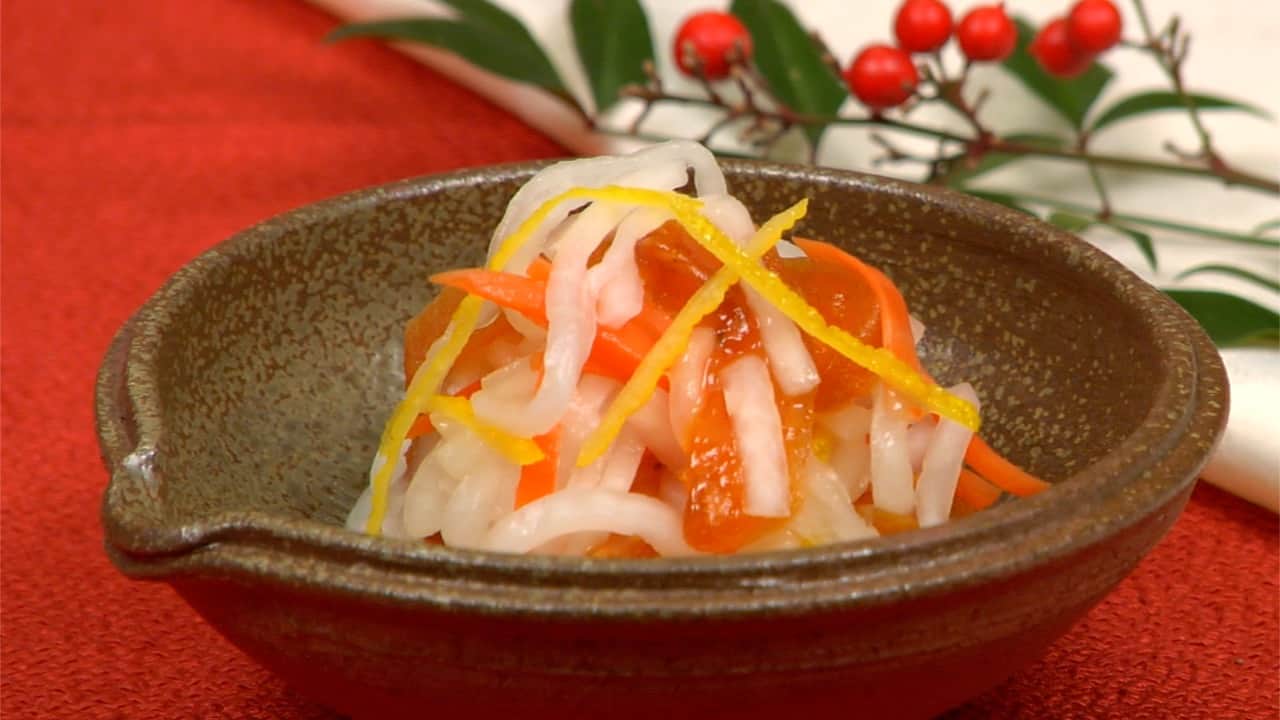
Kohaku-namasu (Daikon and Carrot Salad)

Kitchen Adventures – Crown Tournament 2019: Kohaku-namasu (Daikon and Carrot Salad)

Kohaku-namasu – daikon and carrot salad lightly pickled in sweet vinegar
Kohaku-namasu (Daikon and Carrot Salad)
Photo © Cooking with Dog, used under CC BY-NC 4.0.

Originally published 11/25/2019 Updated 11/6/2025

A symbolic red-and-white salad of daikon and carrot lightly pickled in sweetened vinegar — a bright accent to the first tray of the Muromachi-period Honzen Ryori feast.

Kohaku-namasu represents more than flavor: the colors themselves are auspicious. Red symbolizes joy and protection from evil; white represents purity and celebration. The dish was introduced from China during the Nara period and became a central feature of Osechi Ryori — the traditional New Year’s cuisine of the Heian court.

Crown Tournament 10/19/2019 Mikawa ae (Miso & Sesame Cucumber Pickles)

Crown Tournament 2019: Mikawa ae (Miso and Sesame Cucumber Pickles)

From the Muromachi-period Honzen Ryori menu served at Crown Tournament (October 19, 2019): crisp cucumbers dressed in a miso–sesame emulsion, bright with rice vinegar and shiso.

Mikawa ae – miso and sesame dressed cucumber slices, as served at Crown Tournament 2019
Mikawa ae — Photo courtesy of Avelyn Grene (Kristen Lynn)

Originally published 11/25/2019 Updated 11/6/2025


This beautifully simple dish was a standout on the first tray. The balance of salt, sweetness, and umami offered a refreshing counterpoint to the grilled and simmered items. The redaction draws on Sengoku Daimyo’s Redactions of Japanese Dishes, aligning with techniques seen in late medieval Japan.

Pork Custard (Charlette) – Medieval Meat-and-Milk Dish from Harleian MS. 279 (c.1430)

Pork Custard (Charlette) – Medieval Meat-and-Milk Dish from Harleian MS. 279 (c.1430)

Pork Custard (Charlette) from Harleian MS. 279: a pressed, sliceable medieval ‘hard custard’ with pork
“.lvj. Charlette” – Pork Custard, Harleian MS. 279 (c.1430)Photo: Give It Forth

Originally published 1/16/2017 Updated 10/31/2025

Among the most puzzling entries in Harleian MS. 279 is “.lvj. Charlette” — a firm, sliceable custard of milk, pork or veal, eggs, and ale. It sits at the edge of pudding, cheese, and meat pie: a now-rare style sometimes dubbed a “hard custard.”

The name is often glossed as “meat-milk” (with char “flesh/meat” and –lette “milk”), and similar “milk-meat” recipes turn up in The Forme of Cury and A Noble Boke off Cookry. Medieval diners would have found it robust and nourishing; to modern eyes it can look… challenging. But as a piece of culinary archaeology, it’s priceless.

🥕 Dietary notes: contains meat & dairy; not vegetarian. Gluten-free if using GF ale. Try a mushroom variant for testing.

Lost Techniques Spotlight: Curds-by-Ale & the “Hard Custard” Family

  • Ale-curdling, not sweet-setting: Here, hot milk is curdled by adding beaten eggs and a little ale as the acid; the eggs help bind fine curds around minced meat.
  • Kin to egg-cheese & posset: The method sits between fresh cheese (acid + heat) and early egg-thickened drinks (posset). Pressing the curds overnight makes a sliceable loaf.
  • Savory custards fade: By the 16th–17th c., European tastes shift toward sweet, cream-based, gently baked custards. Savory “hard custards” like charlette mostly vanish.
  • Service tip: Medieval directions say to press the loaf and reheat slices in hot broth. This keeps texture tender and adds flavor.

Feast planning: Make a day ahead so it presses and chills fully. Slice cold; reheat in beef or capon broth at service.

Fukujinzuke – “Seven Lucky Gods” Pickles for Japanese Curry

Fukujinzuke pickles—daikon, lotus root, cucumber—soy-pickled and served with curry rice.
Fukujinzuke (red pickles for curry) 福神漬け
Photo courtesy of Avelyn Grene (Kristen Lynn)

Originallypublished 10/29/2029 Updated 10/31/2025

Fukujinzuke (福神漬け) is a sweet–salty soy-pickled relish traditionally served with Japanese curry rice (kare-raisu). Its name honors the Shichi Fukujin—the Seven Lucky Gods—each symbolizing a different virtue. A classic preparation uses seven vegetables such as daikon, lotus root, cucumber, eggplant, carrot, shiitake, and burdock.

Though curry and fukujinzuke date from Japan’s Meiji era (1868–1912), these pickles trace their roots to far older preservation arts. Including them in the Crown Tournament Feast provided guests with a glimpse of how Japanese foodways evolved from the Muromachi period’s elegant honzen ryōri to later, modern tastes.

Tsukemono—Japanese pickles—form an essential part of nearly every meal. They cleanse the palate, add color and texture, and reflect regional produce and technique. Methods range from simple salt cures (shiozuke) and vinegar brines (amasuzuke) to soy-based (shoyuzuke), miso (misozuke), rice-bran (nukazuke), and sake-lees (kasuzuke) fermentations.

Our fukujinzuke is a shoyuzuke: vegetables simmered briefly in a soy–sugar–vinegar brine for a glossy, gently candied finish. Commercial versions are often tinted red; traditional homespun ones remain soy-brown. A sliver of beet can replace the food dye for color if desired.

🥕 Dietary Notes: Vegan & vegetarian. Contains soy. For gluten-free, use tamari. Omit candied ginger for low-sugar or allium-free adaptation.

Capon Farced – Medieval Chicken Stuffed with Sausage, Onions & Grapes (Harleian MS 279, 1430 | Baronial Twelfth Night Feast)

Capon Farced – Medieval Chicken with Grapes & Sausage (Harleian MS 279, 1430) | Baronial Twelfth Night Feast
Spatchcocked roast chicken with farce (sausage) balls, giussel sauce, and pickled blueberries (barberry stand-in)
Twelfth Night Feast: Spatchcocked roast chicken with “farce” balls and giussel, plus pickled blueberries (a barberry stand-in).

Originally published 12/31/202 Updated 10/30/2025 

Capon Farced (stuffed capon) is a showpiece bird from Harleian MS. 279 (c. 1430): parsley and suet are parboiled, then mixed with hard-boiled egg, spices, and fruit (grapes “in time of year,” or onions), sometimes with minced pork, to stuff and roast the bird. For our Baronial Twelfth Night Feast, I adapted the recipe using a modern spatchcock roast and served the farce as sausage balls on the side for even cooking and speed at scale.

Feast Course Companions on the Table
Second Course — Highlight Capon Farced (this dish), Guissell, Pickle for the Mallard, Roasted Chestnuts, Turnips & Sage, Pickled Barberries

🌟 Explore the full menu: Baronial Twelfth Night Feast Hub

Humoral Balance & Kitchen Technique

In medieval dietetics, poultry was considered warm and moist—suitable to winter. Sweet fruit and fragrant spices (ginger, cinnamon, cloves—optionally saffron) moderated the richness of suet and meat. Historically, stuffing kept birds moist at a hearth; for modern feast service, spatchcocking (removing the backbone to flatten the bird) ensures fast, even roasting and crisp skin without drying the meat.

How to Spatchcock (Butterfly) a Chicken

With sturdy kitchen shears, cut along both sides of the backbone (around the “parson’s nose”) and remove it. Flip the bird breast-side up and press firmly over the breastbone until it lies flat. It’s easiest when slightly firmed from the chill; expect a few crunches—normal!

Homemade Vegetable Stock Powder – DIY Bouillon with Historical Tips

Homemade Vegetable Stock Powder – DIY Bouillon with Medieval “Powdour” Roots

Homemade Vegetable Stock Powder – DIY Bouillon & Historical Tips

Learn how to make vegetable stock powder, vegetable stock, and homemade bouillon from scratch. Perfect for medieval-inspired cooking, camp meals, and budget-friendly feasts.

Originally published: 8/9/2025  |  Updated: 10/30/2025

Dietary Notes 🥕: Vegan • Vegetarian • Gluten-Free. Low-sodium: see tips below. Allergen-friendly: no nuts, dairy, soy; skip nutritional yeast if sensitive and sub mushroom powder.

To Make Callishones – Elizabethan Coriander Marchpane Candies (John Murrell, 1621)

To Make Callishones – Coriander-Scented Marchpane Candies (John Murrell, 1621)
Callishones drying on the stovetop, almond and coriander sweets
Callishones drying on the stovetop — fragrant marchpane sweets gilded with coriander and gold dust.

Updated: October 30, 2025 | Originally Published: 9/17/2015

Part of the Baronial 12th Night series.

To Make Callishones – Coriander-Scented Marchpane Candies

This elegant sweetmeat comes from John Murrell’s A Daily Exercise for Ladies and Gentlewomen (1621), a household guide filled with refined banqueting recipes — comfits, marchpanes, fruit pastes, and perfumed lozenges meant to close an Elizabethan feast. Callishones (or calysons) were pressed from almond paste and spiced with coriander and musk, then dried into aromatic lozenges.

The Elizabethan Banqueting Course

In the Elizabethan and Jacobean eras, a banqueting course was a distinct final act of a feast — a separate table laden with sugarwork, spiced wines, candied fruits, comfits, and perfumed pastes. These dishes were not meant to fill the stomach but to delight the senses and demonstrate refinement.

The fashion for such displays began in the Tudor court and reached its height under Elizabeth I, when sugar was imported from Madeira, the Azores, and later the Caribbean. Wealthy hosts commissioned sugar plate sculptures and marchpane castles, while smaller households imitated them with printed or molded sweets like callishones. The very word “banquet” came to mean not a meal, but a ceremonial table of confections.

Surviving accounts from royal and noble households show that banqueting rooms were sometimes separate from dining halls — built atop towers or in garden pavilions — so that guests could “walk to the banquet” after dinner and admire both the view and the artistry of the table.

Gyngaudre – A Medieval Fish Liver Stew (Harleian MS. 279, c. 1430)

Gyngaudre – Medieval Fish Liver Stew from Harleian MS. 279 (c. 1430)

Gyngaudre – Medieval Fish Liver Stew from Harleian MS. 279 (c. 1430)

Originally published July 2015 · Updated October 28, 2025


Illustration from The Book of Wonders of the Age (St Andrews ms32).

Fish in the Medieval Diet: During the Middle Ages, fish was an essential protein for both the pious and the practical. Church fasting rules forbade meat from warm-blooded animals on Fridays, during Lent, and other holy seasons—amounting to nearly one-third of the year. Preserved and freshwater fish therefore became dietary staples across all social classes, and creative dishes like Gyngaudre ensured nothing was wasted.

Context & Historical Background

Gyngaudre (sometimes written Jingandre or Gyngawdre) is a rare entry in Harleian MS. 279 (c.1430), one of the great English culinary manuscripts of the 15th century. It appears alongside many Lenten and fasting-day recipes, where fish replaces red meat or poultry. The dish is a rich fish-liver stew, thickened and sharpened with wine, vinegar, saffron, and pepper.

Offal dishes—especially those made with liver and roe—were prized for their perceived nourishment and humoral warmth. According to medieval dietetic theory, liver was considered “hot and moist,” believed to restore vitality and promote sanguine balance. Fish livers, particularly from eel or cod, were thought especially rich in essence and restorative for those weakened by fasting.

Modern readers may balk at the idea of fish offal, but in its day this would have been a luxurious and economical dish—making use of every edible part of valuable seafood during Lent or “fish days.” Today, cod liver remains a delicacy in parts of Northern Europe, often canned in its own oil.

About the Source

Harleian MS. 279 is one of two major medieval English cookbooks compiled for upper households in the early 15th century (the other being Harleian MS. 4016). Its recipes show a transition between heavily spiced, sauce-rich medieval fare and the more refined early Tudor palate. “Gyngaudre” reflects that shift—spiced, fragrant, but comparatively simple.

What Is a “Fish Pouch”?

The manuscript calls for “the Pouches and the Lyuerys.” The term pouch may refer to the roe sac, as in “fish pouch of eggs,” or possibly a scribal error for “paunch”—meaning belly. Both interpretations fit a recipe focusing on rich internal organs. For modern cooks, roe or belly meat are both acceptable substitutes.

Modern Safety Note

While medieval cooks used offal liberally, modern dietary safety recommends avoiding fish livers from unknown sources due to possible toxin accumulation. If you wish to attempt this dish, use clean, cold-water species and ensure all organs come from a safe, traceable source. Alternatively, substitute filleted fish and roe for a milder and safer experience.