} -->
Showing posts with label Sides & Accompaniments. Show all posts

Medieval Braised Kale and Collards in Beef Broth (Lange Wortys de Chare)

Medieval Braised Greens in Beef Broth - Lange Wortys de Chare

Lange Wortys de Chare, medieval braised greens simmered in beef broth and thickened with bread.

Much like Caboges, this dish of mixed greens braised in beef broth is far better than it appears at first reading.

A simple dish of greens? No. This is kale and collards, or other sturdy greens, first parboiled, then simmered again with beef, marrow bones, saffron, salt, and grated white bread. The result is not a sad little bowl of boiled leaves. It is a savory, bread-thickened pottage with rich broth clinging to the greens.

At a glance: This is a 15th-century English greens recipe from Harleian MS 279. The greens are cooked twice, enriched with beef broth and marrow bones, seasoned with saffron and salt, and thickened with grated white bread.

That is what medieval cooks did so well. They took humble ingredients and gave them structure, seasoning, fat, and patience.

What Is Lange Wortys de Chare?

Lange Wortys de Chare appears in Harleian MS 279, a 15th-century English cookery manuscript edited by Thomas Austin in Two Fifteenth-Century Cookery-Books. The title may be understood as long wortes, or leafy greens, cooked with flesh. In this case, the flesh is beef with marrow bones.

This recipe belongs to the same family of medieval greens and vegetable pottages as Medieval Wortys, Lange Wortes de Pesoun, Joutes, Whyte Wortes, and Caboges.

Why Did Medieval Cooks Boil Greens Twice?

This recipe asks the cook to parboil the greens first, then cook them again in the beef broth. That may sound redundant, but it is an important part of the method.

Many sturdy greens, especially members of the brassica family such as kale, collards, cabbage leaves, and mustard greens, can be bitter or tough. The first boiling softens them and removes some harshness. The second cooking gives them flavor. Plain water takes something away; broth gives something back.

Kitchen lesson: The first boil tames the greens. The second boil feeds them. This is the difference between plain boiled greens and a medieval pottage worth serving.

That is still good kitchen sense. Modern cooks do similar things with collards, kale, mustard greens, and other bitter greens when they simmer them with stock, fat, smoked meat, or seasoning. Medieval cooks were not merely enduring greens. They were making them delicious.

Caboges and Lange Wortys: Cousins in the Pot

Caboges and Lange Wortys de Chare use nearly the same technique. Both recipes begin by parboiling the vegetable, then cooking it again in broth with marrow or marrow bones. Both use saffron and salt. Both are thickened with grated bread.

The difference is the vegetable. Caboges uses cabbage. Lange Wortys de Chare uses leafy greens. If Caboges is the cabbage cousin, Lange Wortys de Chare is the earthier, greener sibling.

What Greens Can You Use?

I used a mixture of kale and collards, which works beautifully. Both are sturdy greens and fit well with the medieval idea of wortes or coleworts. Other good choices include mustard greens, turnip greens, beet greens, cabbage leaves, or a mixture of bitter and mild greens.

I would avoid using only tender spinach unless you want a very soft result. Spinach cooks quickly and does not behave like kale or collards in a long simmer. This recipe wants greens with some backbone.

Best modern greens: kale, collards, mustard greens, turnip greens, beet greens, cabbage leaves, or a mixed pot of sturdy bitter greens.

For a deeper discussion of medieval wortes, coleworts, and the brassica family, see my post on Medieval Wortys.

Why Add Bread to Braised Greens?

The manuscript calls for a loaf of white bread to be grated into the pot. This is not filler. Bread was one of the great medieval thickeners, used in sauces, soups, stews, and pottages. Grated white bread dissolves into hot broth and gives it body, turning thin cooking liquid into something soft, rich, and spoonable.

For modern cooks, day-old manchet or another fine white bread is ideal. It grates better than fresh bread and thickens the broth more smoothly. Add it slowly, stirring well, because bread clumps are stubborn little gremlins.

Why This Dish Belongs at a Feast

Greens were inexpensive, useful, and widely available, but this recipe is not plain poverty food. Beef, marrow bones, saffron, white bread, and the labor of cooking the greens twice all raise the dish. It is budget-friendly compared with showier meats, but still rich enough to belong on a feast table.

This would be an excellent dish for an SCA feast. It is affordable, flexible, and deeply period in technique. It can be served brothier or thicker, lighter on the greens or packed with them. Greens cook down dramatically. A great heap becomes a much smaller pot. That is what greens do.

Greens and Humoral Balance in the Medieval Kitchen

Medieval cooks did not think about food only in terms of flavor. Food was also understood through the lens of humoral theory, in which ingredients were believed to possess qualities such as hot, cold, moist, or dry. Leafy greens were often considered cooling and moistening foods, useful in balancing richer or warmer dishes.

Yet greens could also be viewed as difficult if eaten raw or prepared poorly. This may help explain the careful treatment in recipes such as Lange Wortys de Chare. First the greens are parboiled, softening harshness and bitterness. Then they are cooked again in rich beef broth with marrow and saffron, ingredients associated with warmth, nourishment, and comfort. Bread thickens and softens the dish further, creating something more balanced and sustaining.

Humoral note: The greens begin as cooling, moist, and potentially harsh. The broth, marrow, saffron, and bread transform them into a warmer, richer, more sustaining pottage.

In other words, medieval cooks were not simply boiling vegetables. They were transforming them into food considered more agreeable to the body as well as the table.

Historic Recipe

The recipe below is from Thomas Austin’s edition of Two Fifteenth-Century Cookery-Books. Harleian MS. 279 (ab. 1430), & Harl. MS. 4016 (ab. 1450), with extracts from Ashmole MS. 1429, Laud MS. 553, & Douce MS. 55.

.j. Lange Wortys de chare. Take beeff and merybonys, and boyle yt in fayre water; þan take fayre wortys and wassche hem clene in water, and parboyle hem in clene water; þan take hem vp of þe water after þe fyrst boylyng, an cut þe leuys a-to or a-þre, and caste hem in-to þe beff, and boyle to gederys: þan take a lof of whyte brede and grate yt, an caste it on þe pot, an safron & salt, & let it boyle y-now, and serue forth.

Modern Translation

Take beef and marrow bones, and boil them in clean water. Then take good greens and wash them clean in water, and parboil them in clean water. Take them up from the water after the first boiling, cut the leaves in two or three pieces, and put them into the beef, and boil together. Then take a loaf of white bread and grate it, and add it to the pot with saffron and salt. Let it boil enough, and serve it forth.

Modern Recipe Notes

This interpretation uses kale and collards as the greens, homemade beef stock as the broth, grated bread as the thickener, and saffron as the seasoning. If you have marrow from making the stock, add it at the end so it remains visible and rich.

The original recipe begins with beef and marrow bones boiled in water. For modern kitchens, prepared beef stock is easier. Homemade stock made with marrow bones is ideal.

Wild Brassica oleracea, ancestor of many familiar greens and cabbage-family vegetables. Image originally linked from kottke.org.

Medieval Braised Cabbage with Marrow Bones – Caboges from Harleian MS 279

Medieval Braised Cabbage with Marrow Bones: Caboges from Harleian MS 279

Caboges, a medieval braised cabbage dish from Harleian MS 279, served here with bread.

A humble dish of cabbage can still surprise you.

When I first made this recipe for Caboges from Harleian MS 279, I expected something plain and useful: boiled cabbage, perhaps a little broth, a serviceable green thing on the side of the table. Instead, I found tender cabbage braised in rich broth, scented with saffron, thickened with fine bread, and finished with marrow from the bones. It was cabbage dressed for court.

Even sworn cabbage haters tried it and wanted more. Success!

This recipe is one of several vegetable-forward dishes from Harleian MS 279, a 15th-century English cookery manuscript edited by Thomas Austin in Two Fifteenth-Century Cookery-Books. It belongs in the same delicious family as medieval wortes, Whyte Wortes, Lange Wortys de Chare, and Joutes.

What Are Caboges?

Caboges is the Middle English form of “cabbages.” But this is not simply boiled cabbage. The recipe directs the cook to clean and parboil the cabbage, press it dry, chop it, and then cook it again in fresh broth with marrow bones. The broth is thickened either with grated fine bread or with a strained meat gruel. At service, the marrow is knocked from the bones and placed visibly in the dish.

That finishing touch matters. This is where the recipe moves from plain vegetable cookery into feast-worthy food.

Why Was This Medieval Cabbage Recipe Fit for a Feast?

Modern readers often imagine medieval vegetable dishes as plain or rustic, but medieval cooks knew how to elevate simple ingredients. Here, cabbage becomes noble through treatment:

  • It is cooked twice for better texture and flavor.
  • It is simmered in fresh broth rather than plain water.
  • It is enriched with marrow bones.
  • It is colored and scented with saffron.
  • It is thickened with grated fine bread into a soft pottage.

The cabbage may be inexpensive, but the broth, marrow, saffron, bread, fuel, and kitchen labor all add value. This is one of the joys of medieval cooking: the simplest vegetable can become something luxurious when handled with care.

How Would Caboges Have Been Served?

Caboges would likely have appeared among the wortes, pottages, or vegetable dishes of a medieval meal, served alongside roasted meats, meat pies, bread, or other greens. The marrow bones and saffron suggest a dish meant for a table with resources, not merely a plain household cabbage. This is the kind of recipe that reminds us that medieval feast food was not only about spectacular meats and subtleties. Sometimes the quiet dish at the side of the table was doing serious work.

Why Did Medieval Cooks Use Bread to Thicken Soup and Pottage?

Bread appears throughout medieval cookery as a thickener for sauces, pottages, broths, and stews. Before modern cornstarch, commercial thickeners, or the familiar flour-and-butter roux, cooks often relied on grated bread, soaked bread, ground almonds, egg yolks, or strained grain and meat mixtures to give body to a dish.

In this recipe, the manuscript calls for fayre brede, or fine bread. For a modern kitchen, a day-old manchet or other good white bread works beautifully. It grates more easily than very fresh bread and dissolves into the broth, creating a smooth, velvety texture. I originally made this with grated Rastons, but manchet is likely the better everyday recommendation for readers who want to recreate the dish.

Bread also reflects the no-waste wisdom of the medieval kitchen. Yesterday’s loaf could become today’s sauce, sop, trencher, or pottage. In Caboges, the bread is not filler. It is the quiet magic that turns broth into something spoonable and satisfying.

Why Does the Recipe Offer Bread or Meat Gruel?

The recipe gives two ways to enrich and thicken the dish: grated fine bread, or a strained gruel made from fresh meat. The bread version is more approachable for a modern kitchen and produces a smooth pottage. The meat-gruel version would have made the dish even richer, especially in a busy medieval kitchen where broth, meat, and strained cooking liquids were already part of the day’s work.

Why Do the Marrow Bones Matter?

The marrow bones are not incidental. The recipe tells the cook to boil the cabbage with marrow bones, then knock out the marrow and lay two or three pieces in the dish at service. That means the marrow is both flavoring and garnish.

For modern cooks, bone marrow can feel unfamiliar, but it brings deep richness. Think of it as the medieval equivalent of finishing a dish with butter, olive oil, or the most luxurious spoonful of beef essence imaginable. If you make your own stock with marrow bones, do not waste the marrow. Use it. The manuscript wants you to.

Cabbage in Medieval Food Philosophy

Cabbage and other brassicas were useful, filling, and widely eaten, but they could also be considered coarse, windy, or difficult if poorly prepared. This recipe manages cabbage through careful technique. Parboiling softens and tames it. Pressing removes excess water. The second cooking in broth makes it nourishing. Saffron adds warmth and fragrance, while bread gives the broth body. The result is not limp cabbage water, but a carefully balanced pottage.

Historic Recipe

The recipe below is from Thomas Austin’s edition of Two Fifteenth-Century Cookery-Books. Harleian MS. 279 (ab. 1430), & Harl. MS. 4016 (ab. 1450), with extracts from Ashmole MS. 1429, Laud MS. 553, & Douce MS. 55.

.iiij. Caboges. Take fayre caboges, an cutte hem, an pike hem clene and clene washe hem, an parboyle hem in fayre water, an þanne presse hem on a fayre bord; an þan choppe hem, and caste hem in a faire pot with goode freysshe broth, an wyth mery-bonys, and let it boyle: þanne grate fayre brede and caste þer-to, an caste þer-to Safron an salt; or ellys take gode grwel y-mad of freys flesshe, y-draw þorw a straynour, and caste þer-to. An whan þou seruyst yt inne, knocke owt þe marw of þe bonys, an ley þe marwe .ij. gobettys or .iij. in a dysshe, as þe semyth best, & serue forth.

Modern Translation

Take good cabbages, cut them, pick them clean, and wash them well. Parboil them in clean water, then press them on a clean board. Chop them, and put them in a clean pot with good fresh broth and marrow bones, and let it boil. Then grate fine bread and add it, and add saffron and salt. Or else take good gruel made of fresh meat, strained through a strainer, and add that. When you serve it, knock the marrow out of the bones and lay two or three pieces of marrow in the dish, as seems best, and serve it forth.

Modern Recipe Notes

This interpretation follows the breadcrumb-thickened version of the recipe rather than the alternate strained meat gruel. The first boiling softens the cabbage and removes some of its stronger edge. Pressing the cabbage keeps the final dish from becoming watery. The second cooking in broth gives depth, while the grated bread thickens the broth into a soft pottage.

The saffron is included in the original recipe, but I mark it as optional for modern cooks because of cost. If you have it, use it. It adds color, fragrance, and a little medieval splendor.

Simple ingredients: cabbage, broth, bread, saffron, and marrow.

Dent-de-Lion: Medieval Dandelion Recipes (Buttered Wortes & Joutes)

Dent-de-Lion: The Dandelion in Medieval Cuisine (Buttered Wortes & Joutes)

Dent-de-Lion: The Dandelion in Medieval Cuisine

“What is a weed? A plant whose virtues have not yet been discovered.”
~Ralph Waldo Emerson
Dandelion plant with yellow flowers and toothed green leaves

Originally published May 22, 2015 | Updated June 5, 2026

Updated 6/5/2026: This post has been expanded to current Give It Forth standards with additional historical context, medieval herb use, Harleian MS. 279 interpretation, foraging safety notes, humoral discussion, feast applications, FAQ, and structured recipe data.

Family: Asteraceae
Usage: Culinary, Medicinal
Common names: Dandelion, dent-de-lion, lion’s tooth, blowball, cankerwort, priest’s crown, wild endive

What is dent-de-lion? Dent-de-lion, “lion’s tooth,” is an old French name for the dandelion, referring to the toothed shape of its leaves. In medieval and early modern foodways, dandelion was valued as both a bitter spring green and a useful medicinal herb.

Before dandelions became lawn enemies, they were supper.

Medieval cooks gathered a far wider variety of greens than most of us eat today, and among them was the humble dandelion, known in French as dent-de-lion, or “lion’s tooth,” for the jagged shape of its leaves. Long before people cursed them in tidy lawns, dandelions were gathered deliberately for the kitchen, the physic garden, and the stillroom.

Whether called blowball, lion’s tooth, cankerwort, priest’s crown, or wild endive, the dandelion (Taraxacum officinale) appears in culinary and medicinal traditions stretching through Arabic, Greek, Welsh, French, and later English sources. Europeans intentionally carried dandelions to North America, likely as early as the colonial period, for use as a potherb, medicinal plant, and valuable forage for bees.

In medieval cookery, bitter greens mattered. After long winters and preserved foods, spring herbs and fresh leaves brought color, nourishment, and welcome sharpness back to the table. Dandelions, with their pleasantly bitter leaves and edible flowers, fit naturally into pottages, salads, herb mixtures, and cooked greens.

Dandelion as Food and Medicine

The boundary between food and medicine was not always firm in medieval and early modern households. A useful plant might appear as a salad herb, a boiled green, a tonic, a cooling preparation, or part of a compound medicine. Dandelion belongs in that overlap. Its leaves are edible, its flowers are useful, and its roots appear repeatedly in medicinal traditions.

Historical texts show the dandelion’s importance across several centuries:

  • 1562 – Bullein’s Bulwarke: Dandelions mixed with roses and vinegar were described as cooling and useful against excess heat.
  • 1587 – The Good Husvvifes Iewell: Dandelion roots appear in a preparation for tissick, or lung complaints.
  • 1629 – Parkinson’s Paradisi in Sole: Dandelion is noted among plants used in compound medicines, especially those concerned with cleansing and liver complaints.

That medical reputation helps explain why the plant remained useful. Bitter herbs were valued not only for flavor, but also for what they were believed to do in the body. Dandelion’s bitterness made it part of the wider world of spring greens, cleansing herbs, and plants used to restore balance after winter’s heavier foods.

⚖️ Humoral note: Later medieval and early modern herbals often understood bitter greens through the language of cooling, cleansing, and correcting excess heat or heaviness. Dandelion’s sharp, bitter leaves fit comfortably into this logic, especially as a spring green eaten after the preserved and salted foods of winter.

Medieval Greens at the Table

Medieval people ate a much wider range of greens than many modern households. The word “wortes” could refer broadly to edible herbs, greens, and vegetable matter cooked together. A medieval cook did not need a single fixed mixture. The recipe depended on the season, garden, market, and what could be gathered.

Dandelion leaves are especially plausible in this world of flexible greens. Young leaves are tender and less bitter. Older leaves are stronger and better suited to cooking. Like sorrel, nettles, beet greens, cabbage leaves, leeks, parsley, and other potherbs, dandelion could be used where a recipe called for “good herbs” rather than a fixed list.

This matters because medieval recipes often assume a cook who already understands the kitchen. They do not always specify every plant, measurement, or timing. Instead, they offer a method: gather good greens, boil them, season them, enrich them, and serve them with bread.

Buttered Wortes from Harleian MS. 279

One of the best places to see this flexible medieval approach is Buttered Wortes from Harleian MS. 279, a fifteenth-century English cookery manuscript.

Original Recipe:
“Take al maner of good herbes that thou may gete... putte hem on fire with faire water; put þer-to clarefied buttur a grete quantite. Whan thei ben boyled ynogh, salt hem... Dise brede small in disshes, and powr on the wortes, and serue hem forth.”

The phrase “all manner of good herbs that thou may get” is the heart of the recipe. It gives the cook permission, and perhaps an expectation, to use what is available. Dandelion does not need to be named specifically to fit the dish. It belongs to the same family of edible, seasonal greens a medieval cook might gather, especially in spring.

The method is simple but effective. Greens are boiled in clean water, enriched with clarified butter, salted, and served with diced bread. The bread matters. It turns a pot of greens into a filling dish, catching the buttery cooking liquid and making the pottage more substantial.

🌿 Medieval kitchen note: Buttered Wortes is not a single-vegetable recipe. It is a method for seasonal greens. Dandelion can be one part of the mixture rather than the entire dish.

Krambe - Roman Cabbage with Caraway, Fish Sauce, and Herbs

Krambe – Roman Cabbage with Caraway, Fish Sauce, and Herbs

Push for Pennsic 2004 Early Roman feast spread with Roman-inspired cabbage and other dishes

Course: Mensa Prima (Main Course / Vegetable Side)
Origin: Ancient Rome
Served: Warm or cold
Event: Push for Pennsic 2004 – Early Roman Feast

Originally published: June 29, 2025 | Updated: June 3, 2026

Updated 6/3/2026: This post has been refreshed to current Give It Forth standards with expanded historical context, clearer recipe formatting, feast service notes, dietary notes, FAQ, internal links to the Roman feast series, and updated structured recipe data.

What is Krambe? Krambe is cabbage, a humble but important vegetable in the Roman diet. This Roman-inspired version is boiled until tender, chopped, and dressed with olive oil, wine, liquamen or fish sauce, caraway, onion, coriander, salt, and pepper.

Krambe in the Roman Feast

This cabbage dish was served as part of the Push for Pennsic 2004 – Early Roman Feast, where it appeared in the mensa prima, the more substantial part of the meal. After the opening course of olives, flatbread, sausages, cucumbers, and cheese spread, dishes like cabbage, chickpeas, and smoked ham gave the feast its heartier center.

Krambe works especially well for large feast service because it is inexpensive, sturdy, and flexible. It can be served warm, cooled, or chilled, and its dressing gives a plain vegetable enough brightness to stand beside richer Roman-inspired dishes.

The combination of olive oil, wine, fish sauce, onion, caraway, and herbs gives the cabbage a sharp, savory flavor. It is not a modern mayonnaise-based cabbage salad. It is closer to a dressed cooked vegetable: tender, seasoned, aromatic, and practical for event cooking.

🏛️ Roman feast note: Krambe pairs well with Lucanicae, Erebinthoi Knakosymmigeis, and Petaso paro Mustacei. Its acidity and herbs help balance the richer dishes on the table.

Historical Background

“Krambe,” from Greek krambē, refers to cabbage, a vegetable that appears frequently in discussions of ancient food and medicine. Cabbage was a common food, but it also carried a strong reputation as a useful household remedy.

Roman authors such as Cato the Elder praised cabbage for its supposed medicinal properties. In De Agricultura, Cato gives cabbage an almost heroic place among garden plants, treating it as useful for digestion, health, and recovery. Whether or not we accept those claims today, they show how seriously Romans could regard an ordinary vegetable.

Apicius also includes cabbage preparations, reminding us that cabbage was not only medicinal or humble. It could be dressed, seasoned, and brought to table as part of a flavorful meal. Roman cooks often relied on combinations of oil, wine, vinegar or wine-based liquids, herbs, spices, and liquamen to make simple ingredients lively.

This version reflects that Roman habit of treating vegetables with strong seasoning. The fish sauce provides salt and depth, the wine sharpens the dressing, the olive oil enriches the cabbage, and the caraway gives a warm aromatic note.

⚖️ Humoral note: Later medieval dietary theory often treated cabbage as a vegetable that could be heavy or windy if poorly prepared. Boiling, draining, seasoning, and dressing it with warming spices and sharp liquids would have made practical sense to later cooks, even though this recipe is Roman-inspired rather than medieval.

Roman Chickpeas with Saffron (Erebinthoi Knakosymmigeis) – Ancient Roman Recipe

Roman Chickpeas with Saffron – Erebinthoi Knakosymmigeis

Push for Pennsic 2004 – Early Roman Feast
Course: Mensa Prima (Main Course / Legume Side)

Origin: Ancient Rome
Served: Warm
Event: Push for Pennsic 2004 – Early Roman Feast

Originally published: June 29, 2025 | Updated: June 3, 2026

Updated 6/3/2026: This post has been refreshed to current Give It Forth standards with expanded historical context, clearer recipe formatting, feast service notes, dietary notes, FAQ, internal links to the Roman feast series, and updated structured recipe data.

What are Erebinthoi Knakosymmigeis? Erebinthoi are chickpeas, and this Roman-inspired preparation simmers them simply with saffron and salt. The dish is warm, fragrant, filling, and useful as a legume-based side in an Early Roman feast.

Erebinthoi Knakosymmigeis in the Roman Feast

These saffron chickpeas were served as part of the Push for Pennsic 2004 – Early Roman Feast. They belong naturally in the mensa prima, the more substantial part of the meal, where legumes, cooked vegetables, and meats helped anchor the feast after the opening gustum.

Chickpeas are practical feast food. They are inexpensive, filling, easy to scale, and able to hold flavor without needing complicated service. For a primitive or outdoor event, a warm legume dish can be especially useful because it brings substance to the table without relying on fragile last-minute plating.

This recipe is intentionally simple. The chickpeas are soaked, simmered, seasoned with salt, and colored and perfumed with saffron. The result is not a heavily sauced dish. It is a minimalist preparation that lets the creamy texture of the chickpeas and the fragrance of saffron stand forward.

🏛️ Roman feast note: Erebinthoi Knakosymmigeis pairs especially well with Krambe, Lucanicae, and Petaso paro Mustacei. It gives the meal a sturdy legume component and balances richer meat dishes.

Historical Background

Chickpeas, known in Greek as erebinthoi, were a familiar food in the ancient Mediterranean. They could be eaten in a variety of ways: boiled, roasted, seasoned, used in porridges, or served as part of broader vegetable and legume dishes.

Roman and Greek medical writers discussed legumes in terms of digestion, nourishment, and bodily effect. Authors such as Galen and Celsus refer to foods not only as ingredients, but as part of a wider understanding of health and diet. Chickpeas, like other legumes, were valued because they were sustaining, accessible, and substantial.

The addition of saffron makes this otherwise humble dish feel more refined. Saffron was an expensive aromatic spice, valued for its color, fragrance, and association with luxury. In the Roman world, saffron could appear in food, scent, ceremony, and elite display. Even a small pinch changes the dish: the chickpeas take on a golden hue and a warm, floral aroma.

Did You Know?
Saffron was so precious in Roman times that it was sometimes used as perfume, scattered in public spaces, or associated with elite entertainments. In this dish, it elevates a humble legume into something suitable for a feast table.

This contrast between ordinary chickpeas and costly saffron is part of the appeal. The dish remains simple and nourishing, but the saffron adds a small golden flourish, turning a basic legume into a feast-worthy side.

⚖️ Humoral note: Later medieval dietary theory often treated legumes as substantial and sometimes difficult to digest if poorly prepared. Soaking, simmering until tender, and serving warm would all make practical sense. Although this is a Roman-inspired recipe rather than a medieval one, the concern for digestibility and balance carries forward into later food writing.

Insalata di Carote – Roasted Renaissance Carrot Salad (Primo Servitio)

Published: May 21, 2026

Insalata di Carote – Roasted Renaissance Carrot Salad (Primo Servitio)

Insalata di Carote, or carrot salad, appears as part of the Primo servitio posto in tavola, the first service placed upon the table, in the Carnivale Feast menu inspired by Domenico Romoli’s sixteenth-century Italian banquet tradition.

At first glance, this seems like one of the humbler dishes on the table. It appears beside chicory salad, shredded prosciutto, cold pressed head meat, citron dressed with rose vinegar, cold roasted crane, capers, capons, and Bolognese sausages. Yet this simple roasted carrot dish became one of the quiet successes of the feast. The carrots were sweet, almost parsnip-like, and the bright oil-and-vinegar dressing brought them beautifully into balance. By the end of the meal, not a single carrot remained.

Roasted Renaissance carrot salad with hand-torn prosciutto served on a wooden platter
Insalata di Carote served feast-style with hand-torn prosciutto. The original menu lists carrot salad and shredded prosciutto separately, but they paired beautifully on the same platter.

The Original Menu Context

Primo servitio posto in tavola

Insalata di cicoria bianca, insalata di carote, prosciutto sfilato, testa di ruffolatto fredda, fette di cedro condite con aceto rosato, zuccaro & cannella, grue arrosta fredda, capperini, capponi salpamentati & salsiccioni bolognesi.

Translation: White chicory salad, carrot salad, shredded prosciutto, cold pressed head meat, slices of citron dressed with rose vinegar, sugar, and cinnamon, cold roasted crane, capers, capons salpamentati, and Bolognese sausages.

This carrot salad belongs to the same opening service as Insalata di Cicoria Bianca con Uva Passera e Scalognetti, another light salad dish from the Carnivale Feast. Together, these dishes helped create contrast at the beginning of the meal: bitter greens, sweet roots, sharp vinegar, salty cured meat, preserved fruit, and rich cold meats.

What Was the Primo Servitio?

In Renaissance Italian dining, a servitio was not simply a modern course in the plated sense. It was a structured presentation of several dishes placed before the diners, often emphasizing variety, abundance, and contrast. The primo servitio posto in tavola, or first service placed on the table, acted as the opening movement of the banquet.

Rather than immediately overwhelming diners with the richest foods, the first service often included dishes that awakened the appetite: salads, dressed vegetables, cured meats, preserved fruits, capers, and cold or temperate preparations. These foods offered brightness, acidity, salt, sweetness, and texture before the heavier dishes of the meal appeared.

That makes a carrot salad more important than it first appears. It is not merely a side dish. It is part of the architecture of the table.

Italian Food, French-Style Service

For this modern recreation, the Carnivale Feast was served in a French-style manner, with multiple dishes available at once for diners to sample. This is a practical and familiar way to serve a historical feast today, especially when cooking for a group without the army of servers, carvers, and attendants available to elite households of the past.

Sixteenth-century Italian banquet service had its own logic. Dishes were organized into services, and many foods passed through the credenza, or sideboard, where they could be arranged, sliced, dressed, garnished, or otherwise finished before appearing at table. Cool and temperate dishes such as salads, cured meats, preserved fruits, and dressed vegetables were especially suited to this kind of preparation.

In the original menu, insalata di carote and prosciutto sfilato are listed as separate dishes. At feast, because serving dishes were limited and because the flavors worked so well together, the hand-torn prosciutto was placed over the roasted carrots. This should be understood as a feast presentation choice rather than a claim that the original dish required prosciutto. Happily, the pairing was delicious.

Reconstructing a Missing Recipe

No direct prescriptive recipe for insalata di carote has yet been identified in the Italian culinary sources consulted for this project. This is not unusual. Historical menus often preserve the names of dishes without explaining how they were prepared, especially when the preparation may have been familiar to contemporary cooks.

For this reconstruction, I consulted Platina’s De honesta voluptate et valetudine, Maestro Martino’s Libro de arte coquinaria, Bartolomeo Scappi’s Opera dell’arte del cucinare, and Domenico Romoli’s La singolare dottrina. While these sources do not appear to provide a direct carrot salad recipe, they do support a broader culinary pattern: vegetables could be cooked, cooled or served temperate, and dressed with oil, vinegar, salt, and sometimes spices.

The method used here follows that logic. The carrots were cooked until tender, cooled, and dressed simply with olive oil, vinegar, salt, and pepper. A small touch of honey was added for modern taste, softening the acidity of the vinegar and echoing the sweet-sour balance beloved in Renaissance cooking.

A Comparative Early Modern Sallet

Although the Italian recipe remains elusive, a later English example helps show that cooked root vegetables could indeed be treated as salads in early modern cuisine. Robert May’s The Accomplisht Cook includes a “Diverse Sallet Otherways” made with boiled parsnips arranged with small salad greens, watercress, lettuce, alexander buds, oil, and vinegar. In a modern redaction of that dish, carrots and parsnips are often paired together.

This does not prove that Romoli’s insalata di carote was prepared in the same way. It does, however, support the broader idea that cooked roots dressed with oil and vinegar belonged comfortably within the early modern salad tradition.

A Humble Vegetable at a Noble Table

Carrots have a long and colorful history. The cultivated carrot likely originated in the region of Central Asia and Persia, especially around modern Iran and Afghanistan, before traveling west through trade, agriculture, and Mediterranean exchange. By the medieval and Renaissance periods, carrots were known in Europe, though they were not necessarily the bright orange supermarket carrots most familiar today.

Sixteenth-century Italian cooks may have encountered carrots in several colors, including white, yellow, purple, red, or reddish-orange forms. The standardized sweet orange carrot became more dominant later, especially through Dutch cultivation in the sixteenth and seventeenth centuries. For this recreation, I used modern orange carrots because they were readily available.

That practical substitution is worth noting, but not apologizing for. Modern orange carrots are sweeter and more uniform than many historical varieties, and roasting intensified that sweetness beautifully. In this dish, they became almost parsnip-like, which made them especially pleasing against the sharpness of vinegar and the saltiness of prosciutto.

Humoral Notes

In Renaissance dietary thinking, raw foods were often approached with caution, while cooked vegetables were generally considered easier to digest. Root vegetables such as carrots were associated with warmth and nourishment, especially when cooked. Serving them dressed with oil and vinegar in the first service made sense within the broader logic of the meal: they were gentle, appetizing, and helped prepare the stomach for richer foods to come.

The oil softened the dish, the vinegar sharpened it, and the small touch of honey rounded the dressing. This balance of sweet, sour, salty, and rich flavors is one of the reasons Renaissance food can feel surprisingly modern when handled with restraint.

Butter’d French Beans (1660) — Robert May’s Table Greens for a Holiday Feast

HomeTudor & Stuart Thanksgiving Series › Butter’d French Beans (1660)

Butter’d French Beans (1660) — Robert May’s Table Greens for a Holiday Feast

Part of the Tudor & Stuart Thanksgiving Series — exploring how early modern English cooks transformed simple vegetables into elegant side dishes fit for the season’s most abundant table.

Dutch-style still life of autumn fruits and vegetables representing the Tudor & Stuart Thanksgiving table.
Still Life of Autumn Fruits and Vegetables — shared image for the Tudor & Stuart Thanksgiving Series, evoking abundance and the early-modern feast.

A Gentle Dish for the Early-Modern Table

By the mid-17th century, “French beans” — the New World haricot — had become a fashionable vegetable in England. Robert May includes several recipes for them in The Accomplisht Cook (1660), treating them tenderly with butter, vinegar, and spice. They offer a luminous green note amid the roasts, puddings, pies, and rich sauces of the season — a perfect complement to a modern Thanksgiving table inspired by early modern English cookery.

Historical Context

New World Origins: Haricot beans (Phaseolus vulgaris) are native to Central and South America. Long before European contact, Indigenous farmers cultivated dozens of varieties—green beans, kidney beans, and shelling beans—across Mesoamerica and the Andes. They formed part of the “Three Sisters” agricultural system alongside maize and squash.

Arrival in Europe: Spanish explorers brought these New World beans to Europe in the early 1500s. By the 1530s they appear in Mediterranean gardens; by the 1550s they were fashionable in Italy and France, where they were prized for their thin, edible pods. England, following French horticultural fashion, adopted them slightly later—thus the English name “French beans.”

Adoption in England: By the late 1500s, green beans were grown in English kitchen gardens, though still considered something of an imported delicacy. Herbalists such as John Gerard (1597) describe “the French bean which cometh from beyond the seas,” distinguishing it from the older Old World broad bean (Vicia faba). These slender beans were more tender, easier to cook, and well suited to the new culinary trend of lightly prepared vegetables.

Why They Appear in May (1660): By Robert May’s time, French beans had become a regular feature in elite kitchens. His recipe aligns with the era’s preference for simple treatments—boiling, buttering, and seasoning—allowing the vegetable’s natural color and delicacy to shine. The touch of vinegar and nutmeg reflects early-modern taste for balancing “cold and moist” foods with warming spices.

From New World to Tudor Thanksgiving: The journey of the French bean—from Indigenous agriculture to Spanish ships, to French gardens, to English cookbooks—mirrors the broader Columbian Exchange that reshaped European foodways. Serving this dish at a modern Thanksgiving connects the contemporary holiday table with the very ingredients that transformed 17th-century English cooking.

Original Recipe 

Robert May, The Accomplisht Cook (London: 1660), p. 204.
Public link to the recipe on Archive.org

To stew French Beans.
Take your French beans and string them, then seeth them well in fair water; when they are tender, put them into a pipkin with some sweet butter, a little vinegar, pepper, and salt; and shake them well together. Serve them hot, with grated nutmeg cast upon them.

Sweet Potatoes Three Ways (1660–1670) — May & Woolley at the Early-Modern Table

HomeTudor & Stuart Thanksgiving Series › Sweet Potatoes Three Ways (1660–1670)

Sweet Potatoes Three Ways (1660–1670) — Robert May & Hannah Woolley

Part of the Tudor & Stuart Thanksgiving Series — exploring how early modern English cooks transformed New World ingredients into elegant, comforting, and festive dishes fit for the season’s most abundant table.

Dutch-style still life of autumn fruits and vegetables representing the Tudor & Stuart Thanksgiving table.
Still Life of Autumn Fruits and Vegetables — shared image for the Tudor & Stuart Thanksgiving Series, evoking abundance and the early-modern feast.

A New World Root, Transformed by English Cooks

Sweet potatoes — known in 17th-century England as “Spanish Potatoes” — arrived through Spanish trade routes in the early 1500s. Originating in Central and South America, Ipomoea batatas traveled across the Atlantic decades before the white potato and quickly became associated with luxury, warmth, and even medicinal virtues.

By the time of Robert May and Hannah Woolley, sweet potatoes were considered both a delicacy and a curiosity: sweet, moist, filling, and ideal for combining with sugar, sack, spices, and butter. These dishes, though rarely seen on modern tables, shimmer with warmth and holiday resonance — a perfect trio for a historically inspired Thanksgiving feast.

Expanded Historical Notes: Sweet Potatoes in Early Modern England

New World Origins: Sweet potatoes were cultivated by Indigenous peoples across the Caribbean, Central America, and the Andes long before European contact. Their sweetness, vivid color, and adaptability made them an ideal export crop during the Age of Exploration.

Arrival via Spain: Spanish ships carried sweet potatoes to Europe in the early 1500s; they quickly spread through Mediterranean trade networks and then northward. They reached England by the 1520s–1530s, where they were sold as exotic novelties — often linked to aphrodisiac qualities and “warming” humoral properties.

“Spanish Potatoes” vs. “Potatoes”: Early modern English texts differentiate between:

  • Spanish Potatoes — sweet potatoes
  • Potatoes — the newly introduced white/Irish potato
May uses both terms; Woolley uses both interchangeably depending on the edition. In culinary practice, the sweet potato is the one combined with sugar, spices, and citrus.

Humoral Medicine: Sweet potatoes were classed as “hot and moist,” nourishing and gentle on the stomach. Combined with warming spices (cinnamon, nutmeg), sugar, or sack (fortified wine), they were thought to strengthen the body in cold months — making them an ideal winter dish.

Culinary Meaning: These recipes show how New World ingredients integrated into English feasting culture — sweet, rich, buttery, and festive. Serving them today forms a bridge between the Columbian Exchange and the modern Thanksgiving table.

Period Recipes (Three Ways)

1. Robert May — The Accomplisht Cook (1660)

“To butter Potatoes.”
From The Accomplisht Cook, Book V, p. 225 (1660).
Public link to May’s recipe

To butter Potatoes.
Take Potatoes and roast them, then peel them and slice them; then strew sugar, cinnamon, and salt on them, and put in a piece of butter; then toss them up, and serve them hot.

2. Hannah Woolley — The Queen-Like Closet (1670)

“To Preserve Potatoes.”
Book I, “To Preserve Potatoes.”
Public link to Woolley

To Preserve Potatoes.
Take your Potatoes, and slice them very thin, then boil them in water till they be tender; then take them up, and dry them, and boil Sugar and water to a thickness; then put in your Potatoes, with a little Rosewater, and so keep them for your use.

3. Woolley Tradition — Potato Pottage (17th c.)

Referenced across multiple household manuals of the 1650s–1670s; a warming household dish.

Potato Pottage.
Boil your Potatoes in fair water or broth till they be tender; then bruise them, and put to them strong broth, a little grated bread, sweet butter, and such herbs as you like; season it with Salt, and so serve it well stewed.

Soops and Mashed Potatoes – How a Tudor Luxury Became a Holiday Staple

Soops and Mashed Potatoes – How a Tudor Luxury Became a Holiday Staple

A Dutch still-life of meats, citrus, and salad greens evoking a 17th-century banquet table.
A Dutch still-life evoking the abundance of a 17th-century banquet — a perfect match for the spirit of Thanksgiving.

Editor’s Note: As autumn turns to feast season, the next several posts on Give It Forth explore a different kind of Thanksgiving table — one inspired not by Pilgrims and pumpkins, but by the kitchens of Tudor and Stuart England. These 16th- and 17th-century dishes, drawn from sources like Robert May’s The Accomplisht Cook (1660), showcase the foods and flavors that would have graced a festive English winter board. Presented here in modern form, each recipe offers a way to bring history to an American Thanksgiving — blending Old World elegance with New World abundance.

Historical Note: Today, mashed potatoes feel indispensable on a Thanksgiving table. But in the 17th century, potatoes were still exotic — treated more like a luxurious root or even a dessert component than a plain side. This post traces that transformation through three recipes: Robert May’s Tudor-style “soops,” an early Georgian dish of potatoes “beat up with cream,” and the first printed recipe to use the phrase “mashed potatoes.”

Potatoes reached England in the late sixteenth century, but for a hundred years they remained rare and refined. The following three recipes trace how they evolved from May’s sweet-spiced “soops” to the creamy, savory mashed potatoes we know today.

Green Pudding of Sweet Herbs – A Tudor Boiled Pudding from The Accomplisht Cook (1660)

Green Pudding of Sweet Herbs – A Tudor Boiled Pudding from The Accomplisht Cook (1660)

Editor’s Note: As autumn turns to feast season, the next several posts on Give It Forth explore a different kind of Thanksgiving table — one inspired not by Pilgrims and pumpkins, but by the kitchens of Tudor and Stuart England. These 16th- and 17th-century dishes, drawn from sources like Robert May’s The Accomplisht Cook (1660), showcase the foods and flavors that would have graced a festive English winter board. Presented here in modern form, each recipe offers a way to bring history to an American Thanksgiving — blending Old World elegance with New World abundance.

Historical Note: The Tudors and Stuarts did not celebrate Thanksgiving as we do in America today. This series simply imagines how dishes from their winter feasts — roasts, “made dishes,” puddings, and spiced pies — might have found their way, in spirit and flavor, to the modern table. It’s a chance to explore the shared themes of gratitude, abundance, and seasonal celebration across centuries.

Dutch still-life style roast bird with herbs, citrus, bread and pewter dishes on a dark table.
A 17th-century-inspired feast still life. Alongside the roast, dishes like green puddings of sweet herbs added color and richness to the Tudor–Stuart table.

On a Tudor or early Stuart winter table, not every “pudding” was sweet. Many were savoury, herbal, and vividly green — rich with cream and egg yolks, scented with mace and nutmeg, and studded with currants and dates. Robert May’s “green boil’d Pudding of sweet Herbs” is one of these: a bread-and-cream pudding colored with spinach juice and flavored with a whole garden of herbs.

He tells us that these puddings are “excellent for stuffings of roast or boil’d Poultrey, Kid, Lamb, or Turkey, Veal, or Breasts of Mutton.” In other words, they could be served in slices as a side dish, or used as a rich, herbal forcemeat filling for meat and fowl.

The Original: A Green Boil’d Pudding of Sweet Herbs

To make a green boil’d Pudding of sweet Herbs.

Take and steep a penny white loaf in a quart of cream and only eight yolks of eggs, some currans, sugar, cloves, beaten mace, dates, juyce of spinage, saffron, cinamon, nutmeg, sweet marjoram, tyme, savory, peniroyal minced very small, and some salt, boil it in beef-suet, marrow, (or none.) These puddings are excellent for stuffings of roast or boil’d Poultrey, Kid, Lamb, or Turkey, Veal, or Breasts of Mutton.

This short paragraph carries a great deal of information: it tells us the base (bread and cream), the enrichment (egg yolks, suet, marrow), the “green” element (spinach juice and herbs), the seasoning (currants, dates, sugar, spices), and the preferred cooking method (boiled as a pudding, then served or used as stuffing).

What Is a Boiled Pudding?

In the 16th and 17th centuries, many puddings were cooked not in tins, but in cloth. The mixture was poured into a floured or buttered linen or canvas pudding cloth, tied securely, and boiled in a pot of water or broth until set. Afterward, the pudding was turned out, sometimes browned before the fire, and served in slices. The same method works for both sweet and savoury puddings.
Glossary: Penny Loaf, Spinage, & Peniroyal

Penny white loaf: A small, fine white bread, roughly similar to a modern small boule or 250–300 g of white sandwich bread (without the crusts).

Juyce of spinage: Spinach juice — spinach leaves pounded or blended, then squeezed to extract a vivid green juice used to color and flavor the pudding.

Peniroyal (pennyroyal): A strongly flavored mint family herb. Because modern pennyroyal is not considered food-safe, we omit it here and rely on marjoram, thyme, and savory instead.

Crown Tournament 10/19/2019: O-zōni (Rice Cake Soup – Mochi and Simmered Vegetables with Fish-Paste Cake)


O-zoni (rice cake soup) from the Crown Tournament 2019 feast
O-zoni – Rice Cake and Simmered Vegetables with Fish-Paste Cake
Photo: Avelyn Grene (Kristen Lynn)

Originally published 1/29/2020 Updated 11/6/2025

Kitchen Adventures – Crown Tournament 10/19/2019: O-zoni (Rice Cake Soup)

Context: In Muromachi-period formal dining (honzen ryori), o-zoni is a welcoming soup — a composed bowl of mochi (rice cake), seasonal vegetables, and savory elements in a clear broth. The feast version here uses square kaku-mochi in vegetarian kombu-shiitake dashi so more diners could enjoy it. Regional variations exist, but rice cake is essential.

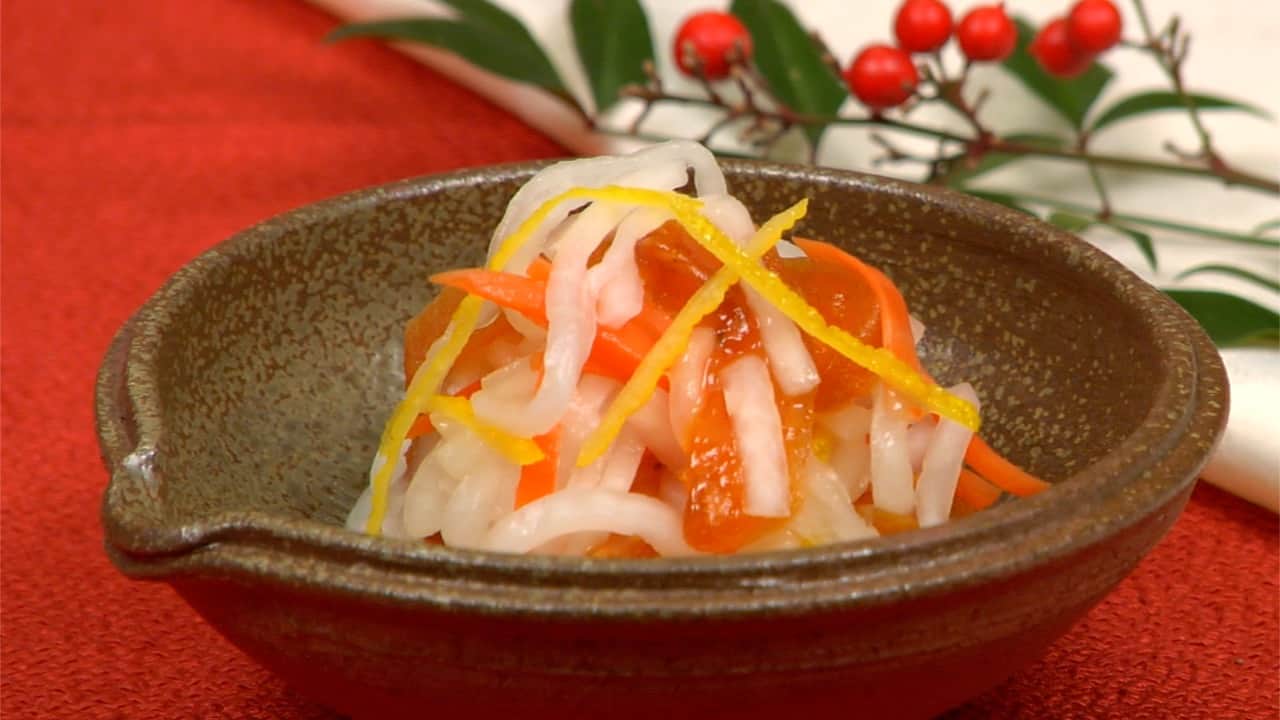
Kohaku-namasu (Daikon and Carrot Salad)

Kitchen Adventures – Crown Tournament 2019: Kohaku-namasu (Daikon and Carrot Salad)

Kohaku-namasu – daikon and carrot salad lightly pickled in sweet vinegar
Kohaku-namasu (Daikon and Carrot Salad)
Photo © Cooking with Dog, used under CC BY-NC 4.0.

Originally published 11/25/2019 Updated 11/6/2025

A symbolic red-and-white salad of daikon and carrot lightly pickled in sweetened vinegar — a bright accent to the first tray of the Muromachi-period Honzen Ryori feast.

Kohaku-namasu represents more than flavor: the colors themselves are auspicious. Red symbolizes joy and protection from evil; white represents purity and celebration. The dish was introduced from China during the Nara period and became a central feature of Osechi Ryori — the traditional New Year’s cuisine of the Heian court.

Crown Tournament 10/19/2019 Mikawa ae (Miso & Sesame Cucumber Pickles)

Crown Tournament 2019: Mikawa ae (Miso and Sesame Cucumber Pickles)

From the Muromachi-period Honzen Ryori menu served at Crown Tournament (October 19, 2019): crisp cucumbers dressed in a miso–sesame emulsion, bright with rice vinegar and shiso.

Mikawa ae – miso and sesame dressed cucumber slices, as served at Crown Tournament 2019
Mikawa ae — Photo courtesy of Avelyn Grene (Kristen Lynn)

Originally published 11/25/2019 Updated 11/6/2025


This beautifully simple dish was a standout on the first tray. The balance of salt, sweetness, and umami offered a refreshing counterpoint to the grilled and simmered items. The redaction draws on Sengoku Daimyo’s Redactions of Japanese Dishes, aligning with techniques seen in late medieval Japan.

Compost – Medieval Pickled Vegetables (The Forme of Cury, c. 1390)

Compost – Medieval Pickled Vegetables (The Forme of Cury, c. 1390)

Compost: a colorful bowl of medieval pickled vegetables
A beautiful dish of Compost—a sweet-sour, mustard-kissed medley of pickled vegetables.
Original adaptation courtesy of Daniel Myers at Medieval Cookery.

Originally published 10/21/2017. Updated 9/19/2025.

Compost is a vibrant “composition” of roots, cabbage, and pear, dressed with vinegar, wine, honey, and spices. Although the modern ear hears “garden compost,” in medieval cookery compost meant a mixture (from Latin componere—“to put together”). The recipe appears in The Forme of Cury (c. 1390), a royal English cookbook compiled by the cooks of King Richard II.

Historical & Cookbook Context

The Forme of Cury is among the earliest English culinary collections, written in Middle English for a professional court kitchen. Richard II’s table favored spice, color, and spectacle—dishes like Compost fit that world perfectly: bright, sweet-tart, and meant to awaken the appetite at the start of a course.

  • Etymology: Compost = “mixture/compote,” not soil. Cognates appear across Europe (composte in Italian/French) for sweet-sour preserves.
  • Preservation: Vinegar + honey + wine weren’t just flavors; they extended shelf life before refrigeration—ideal for travel, fasting days, and feasts.

Compost works beautifully in the first course with other cold dishes: sallets, pottages, and small bites. It’s a make-ahead dish that holds safely, scales easily, and offers welcome acidity between richer foods. Serve in shallow bowls with a draining spoon so guests can take vegetables without over-brine.

Humoral Theory (Balance & Digestion)

Medieval diners aimed to balance foods’ hot/cold and dry/moist qualities. Sharp pickling and mustard were considered “warming” and digestive; honey and currants added moist sweetness, while pear cooled and softened the heat of spice.

Ingredient Humoral Tendency (period belief) Balancing Note
VinegarHot & dryStimulates appetite/digestion
MustardHot & dryWarming; use sparingly for choleric temperaments
Honey & currantsWarm & moistRound out sharpness; “comforting”
PearCool & moistTempers heat of spices and vinegar

Ingredient Notes & Modern Substitutions

  • Parsley root: Traditional but scarce in U.S. markets—sub parsnip or celery root.
  • Greek wine: The text specifies “wyne greke,” likely sweet. Good subs: Muscat, Marsala, or a sweet white. Dry white works in a pinch.
  • Powder douce: A mild sweet spice blend (often sugar + cinnamon + ginger). Use your house blend to match other Curia dishes.
  • Lombard (Lumbarde) mustard: Strong, sweetened mustard with spice—modern “sweet–hot” or honey mustard is close; add a pinch of ginger for warmth.
  • Currants: Zante currants (dried Corinth grapes), not fresh currants. Small raisins are a last-resort sub.
  • Saffron: Optional but period-correct for color and aroma. For budget or camping: a tiny pinch of turmeric for color only.

🥕 Dietary Notes

  • Vegetarian
  • Vegan ✅ (swap honey for date syrup or agave)
  • Gluten-free
  • Allergens: Mustard is common; omit or reduce, or sub a small pinch of prepared horseradish.
  • Camping/Feast friendly: Make 1–2 days ahead; keeps well chilled. Transport brine separately and dress on site for best texture.

Original Text — The Forme of Cury (c. 1390)

Take rote of parsel. pasternak of rasenns. scrape hem waisthe hem clene. take rapes & caboches ypared and icorne. take an erthen panne with clene water & set it on the fire. cast all þise þerinne. whan þey buth boiled cast þerto peeres & parboile hem wel. take þise thynges up & lat it kele on a fair cloth, do þerto salt whan it is colde in a vessel take vineger & powdour & safroun & do þerto. & lat alle þise thinges lye þerin al nyzt oþer al day, take wyne greke and hony clarified togider lumbarde mustard & raisouns corance al hool. & grynde powdour of canel powdour douce. & aneys hole. & fenell seed. take alle þise thynges & cast togyder in a pot of erthe. and take þerof whan þou wilt & serue forth.

Eisands with Oatmeal Groats — A Book of Cookrye (1591)

Eisands with Oatmeal Groats — A Book of Cookrye (1591)

Eisands with Oatmeal Groats: a sliced boiled oat pudding with dates and spice (A Book of Cookrye, 1591)
Eisands with Oatmeal Groats — A Book of Cookrye (1591)

Eisands of otemeal grotes is one of those recipes I knew I had to tackle the moment I found it while researching for a cook’s gathering in 2015. It reads like a bridge between early “puddings” (often meat-and-suet mixtures boiled in an animal casing) and the later sweet, bread- or grain-based boiled puddings that show up in the 17th century—think the ancestors of Christmas plum pudding. The question was how to cook it (bake, steam, boil?) and what exactly the “otemeale grotes” should be in a modern kitchen.

On the oats: “Groats” are hulled whole oat berries. Steel-cut oats (oat groats chopped into pieces) are the easiest modern stand-in and give the right “rice-like” bite. Rolled/quick oats are much later and behave differently; avoid them for authenticity and texture.

On the method: The surrounding recipes in A Book of Cookrye point to boiling the pudding in a cloth. When made this way, Eisands slices beautifully, travels well, and can be served warm or cold—perfect for a Curia Regis Brunch or feast service.

Original & Translation

Original (1591) Modern Sense Translation
Eisands with Otemeale grotes. Take a pinte of Creame and seethe it, and when it is hot, put therto a pinte of Otemeale grotes, and let them soke in it all night, and put therto viii. yolks of egs, and a little Pepper, Cloves, mace, and saffron, and a good deale of Suet of beefe, and small Raisins and Dates, and a little Sugar. Eisands of Oatmeal Groats. Heat a pint of cream; when hot, add a pint of oatmeal groats and let them soak in it overnight. Mix in eight egg yolks; season with a little pepper, cloves, mace, and saffron. Add a good amount of beef suet, along with small raisins and dates, and a little sugar.

Funges – Mushroom & Leek Pottage from The Forme of Cury (c. 1390)

Funges – Medieval Mushroom & Leek Pottage (The Forme of Cury, c. 1390)

Originally published 2017 — updated September 2025

🥕 Dietary Notes: Vegan • Vegetarian • Gluten-Free     

Funges – medieval mushroom and leek pottage tinted with saffron
Funges – a saffron-tinted pottage of mushrooms and leeks from The Forme of Cury, c. 1390.
Humoral Theory: Mushrooms and leeks were considered cold and moist. Saffron, pepper, ginger, and clove were hot and dry correctives, making the dish balanced and easy to digest in the morning.
Menu Placement: Funges works as an early pottage course, served with bread or trenchers, to prepare the stomach before heavier meats and roasts.

Funges is a warming dish of mushrooms and leeks simmered in broth, brightened with saffron and finished with Powder Fort. It’s fast, fragrant, and feast-friendly—perfect for Curia brunch as a gentle starter. If you love leek dishes, see also Canabenys with Lekys.

This dish highlights the medieval love of mushrooms, leeks, and saffron. It is meatless, making it suitable for fast days and Lenten feasts, while still rich and satisfying. Its bright saffron hue and spicy warmth balance the humoral system—warming and drying against damp, cool mornings. Served with bread, it offers both nourishment and elegance, reminding us how medieval cooks turned humble ingredients into royal fare.

Original Recipe

Funges (The Forme of Cury, c. 1390)
Take Funges and pare hem clere and dyce hem. take leke and shred him smal and do him to seeþ in gode broth color yt wȝt safron and do þer inne pouder fort and serve hit forth.

Blawnche Perrye – Creamed Leeks with Rice and Fish (Harleian MS. 279, c.1430)

Creamy leek and rice pottage (Blawnche Perrye) served alongside roasted fish, adapted from Harleian MS. 279, c.1430
Harleian MS. 279 (c.1430) – For to make Blawnche Perrye – Creamed Leeks with Rice

Originally published 3/30/2017 Updated 9/10/2025

In Two Fifteenth-Century Cookery Books (Harleian MS. 279, c.1430), we are told to serve fish — especially eel — with Blawnche Perrye, much as venison was paired with furmenty. Eel was common in medieval England, but difficult to find (and costly) today. For this version, I substituted perch, though monkfish or mullet would be closer to the fatty, firm texture of eel.

This dish sits at the intersection of pottage cookery and fish service. It’s a reminder of the wide variety of fish eaten in the Middle Ages: herring, salmon, eel, cod, pike, turbot, perch, carp, trout, even porpoise and whale. Shellfish such as oysters, cockles, shrimps, crabs, and mussels were also common.

The Original Recipe

.xlv.—For to make Blawnche Perrye.
Take þe Whyte of the lekys, an seþe hem in a potte, an presse hem vp, & hacke hem smal on a bord. An nym gode Almaunde Mylke, an a lytil of Rys, an do alle þes to-gederys, an seþe an stere it wyl, an do þer-to Sugre or hony, an dresse it yn; þanne take powderd Elys, an seþe hem in fayre Water, and broyle hem, an kytte hem in long pecys. And ley .ij. or .iij. in a dysshe, and putte þin perrey in a-noþer dysshe, an serue þe to dysshys to-gederys as Venysoun with Furmenty.

Daniel Myers offers a modernized Middle English transcription on Medieval Cookery, and the recipe is also rendered in Austin’s edition of Two Fifteenth-Century Cookery Books.

Modern Recipe

De la insaleggiata di cipolle – Renaissance Onion Salad with Spices

De la insaleggiata di cipolle – Renaissance Onion Salad (Redon, 1998)

Renaissance banquet scene in Veronese’s House of Levi; a lavish table evocative of spiced dishes like roasted onion salad.
“The Feast in the House of Levi” (detail), Paolo Veronese. Used here as period context for Renaissance spiced vegetable dishes such as onion salad.

Context: De la insaleggiata di cipolle is a medieval-to-Renaissance Italian onion “salad.” Onions are roasted in embers or a hot oven until sweet and soft, then sliced and dressed with wine vinegar, oil, and spezie forti (strong spices). These sharp, spiced starters were common on Italian banquet tables as appetite-whetting openers or vegetable accompaniments in the early courses.

Original Recipe (Libro della cucina, 14th c.)

Italian (Zambrini ed., 1863):
“Togli cipolle; cuocile sotto la bragia, e poi le monda, e tagliale per traverso longhette e sottili: mettili alquanto d’aceto, sale, oglio e spezie, e dà a mangiare.”

English (faithful translation):
“Take onions; cook them under the embers; then peel them, and cut them across into long, thin slices; put on a little vinegar, salt, oil, and spices, and serve.”

Redon paraphrase (1998)

“Roast onions in the fire until blackened. Peel, slice finely, and season with salt, vinegar, oil, and spices.”

This dish reaches us in three layers: the terse 14th-century text, Redon’s Renaissance-informed paraphrase, and the modern tested adaptation below.

Comparison: Medieval → Redon → Modern

Source Text / Notes
Libro della cucina (14th c.) “Cook under embers; peel; slice long and thin; dress with a little vinegar, salt, oil, and spices; serve.”
Redon (1998) “Roast in the fire until blackened; peel; slice finely; season with salt, vinegar, oil, and spices.”
Modern (tested) Gives exact quantities, 500°F oven option, spice blend measure, substitutions, and serving notes.

Modern Recipe (Redon-inspired; tested)

De Lasanis – Medieval Lasagna with Cheese, Pepper & Spices

De Lasanis – Fermented-Dough Noodles with Cheese & Pepper

Renaissance banquet scene in Veronese’s House of Levi; a lavish table evocative of pasta and cheese dishes like De Lasanis.
“The Feast in the House of Levi” (detail), Paolo Veronese. Used here as period context for Renaissance pasta and cheese dishes.

Source: The Medieval Kitchen, Odile Redon, Françoise Sabban, and Silvano Serventi (1998)

De lasanis is one of the earliest references to pasta dishes resembling modern day cacio e pepe. The resemblance is striking — a simple but elegant combination of starch, cheese, and spice that became a cornerstone of Italian cookery. Redon's addition of yeast imparts a tang and complexity most modern cooks miss when substituting dried lasagna noodles. If you can, I recommend making your own—it’s surprisingly easy and richly rewarding.

Fungi di Monte – Renaissance Italian Mushrooms from Scappi (1570)

Fungi di Monte – Renaissance Mountain Mushrooms

Renaissance banquet scene in Veronese’s House of Levi; a lavish table evocative of rich savory pies like garlic torte.
“The Feast in the House of Levi” (detail), Paolo Veronese. Used here as period context for a Renaissance savory pie.
Sources: Bartolomeo Scappi, Opera dell’arte del cucinare, 1570 (Book II, cap. 193); Odile Redon, Françoise Sabban, Silvano Serventi, The Medieval Kitchen, 1998.

Mushrooms were a popular ingredient in Renaissance Italy, eaten in fast-day dishes and served alongside roasted meats. This recipe for Fungi di Monte (“mushrooms of the mountain”) comes to us from Bartolomeo Scappi’s monumental 1570 Opera. Redon adapts it into a clean, modern version while preserving its essential spicing and method.

Historic Recipe (Scappi, 1570)

Per cuocere funghi di monte in più modi. Dopo che saranno ben nettati, si cuociano in acqua calda, & si lascino scolare; poi si facciano soffriggere con cipolla trita, olio, sale, pepe, canella, garofali, & altre buone spetiarie. Si possono anco cuocere con burro fresco, & cacio parmigiano, & similmente si possono friggere in pastello.

Translation

To cook mountain mushrooms in several ways. After they are well cleaned, cook them in hot water and let them drain; then fry them with chopped onion, oil, salt, pepper, cinnamon, cloves, and other good spices. They may also be cooked with fresh butter and Parmesan cheese, and likewise they may be fried in batter.