} -->

Kitchen Adventures – .xxxxix. Sardeyneȝ - Sugared and Spiced Nuts (Harleian MS. 279 (ab 1430))

xxxxix. Sardeyneȝ - Sugared and Spiced Nuts

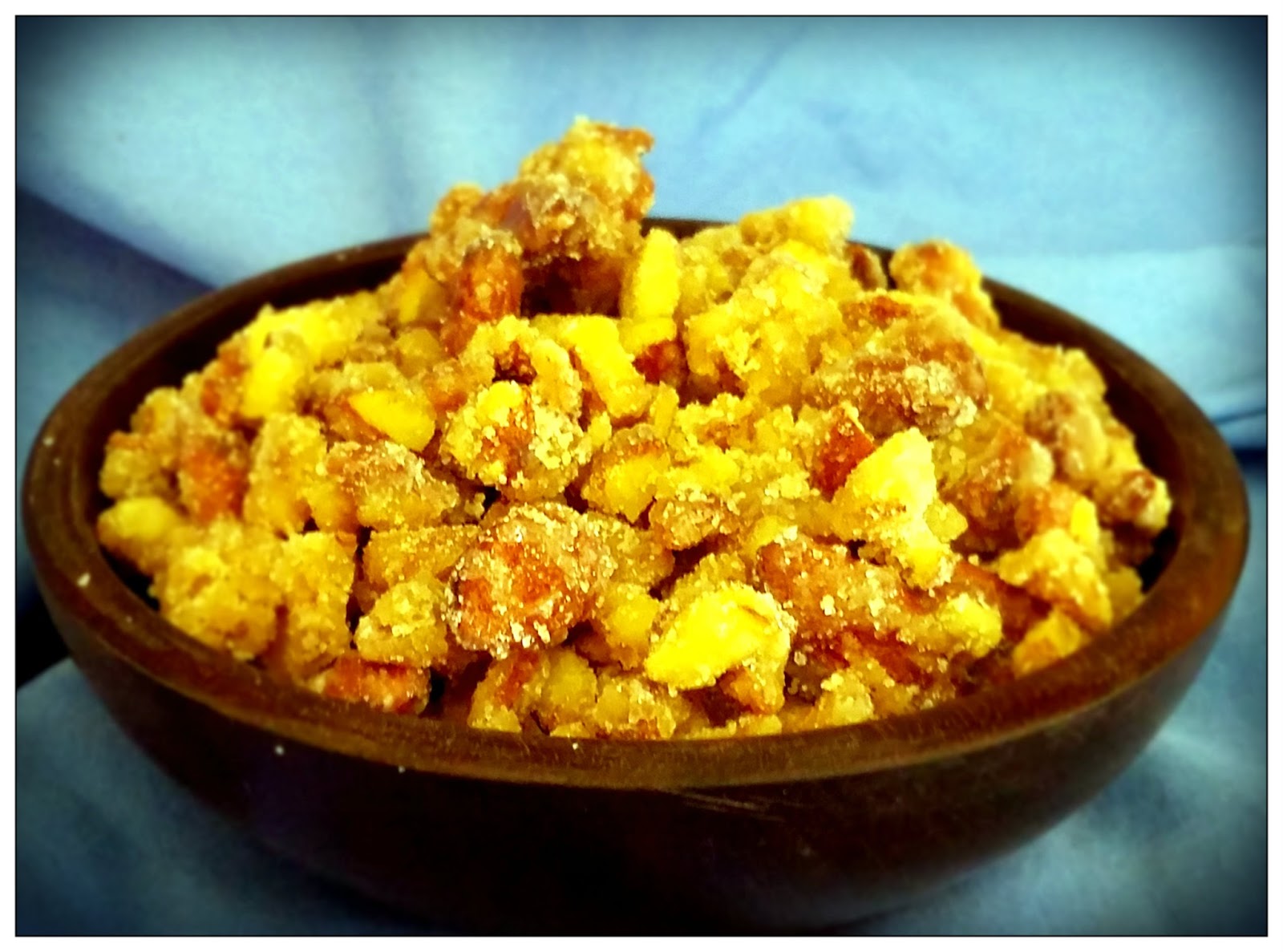
Occasionally you run across a set of instructions that are so vague they  are difficult to interpret.  This is one such recipe.  I must admit I did attempt to locate similar recipes from peers and fellow cooking scholars, but to no avail.  I finally jumped in feet first and created my own interpretation.  If my interpretation is correct it creates something similar to a praline, a spiced and sugared caramalized nut  candy that is D E L I C I O U S!  I am unashamed to admit that I am thoroughly addicted to this interpretation.

This strikes me as unusual because this recipe is found in the "pottage" section of the Two fifteenth-century cookery-books : Harleian MS. 279 (ab 1430), & Harl. MS. 4016 (ab. 1450), with extracts from Ashmole MS. 1439, Laud MS. 553, & Douce MS. 55 by Thomas Austin, so I would expect a pudding, cereal, broth like consistency.  Something magical happens when you add a large amount of sugar to rice milk (make a gode Mylke of Flowre of Rys + a fayre parte of sugre, & boyle hem wyl) --it becomes a caramel. Since we aren't really told what to do with our almonds--I lightly crushed them and  added them to this mixture and voila! A candy I served at Collegium Feast and hid from the taste testers after initial tasting. 

.xxxxix. Sardeyneȝ.—Take Almaundys, & make a gode Mylke of Flowre of Rys, Safroun, Gyngere; Canelle, Maces, Quybibeȝ; grynd hem smal on a morter, & temper hem vppe with þe Mylke; þan take a fayre vesselle, & a fayre parte of Sugre, & boyle hem wyl, & rynsche þin dysshe alle a-bowte with-ynne with Sugre or oyle, an þan serue forth.

49. Sardeyney - Take almonds, and make a good Milk of Flour of Rice, Saffron, Ginger, Cinnamon, Mace, Cubeb; grind them small on a mortar, and temper them up with the milk; than take a fair vessel, and fair part of sugar, and boil them well, and rinse your dish all about within with sugar or oil, and then serve forth.

Interpreted Recipe

1 c. raw almonds
1 c. rice milk (or any nut milk, in a pinch I used almond milk)
Pinch of saffron
1/2 tsp. pouder douce-sugar, ginger, cinnamon, mace (I have a powder given to me as a gift I used)
1/4 tsp. cubebs finely ground
3/4 c.  sugar

A couple of points before we move forward into the actual interpretation of the recipe. Rice milk is something you can easily make at home.  To make your rice flour simply take a quantity of rice and grind it to flour in your blender.  Add liquid of your choice (just like you would for almond milk), grind some more, strain, and you have rice milk.

There are no specific instructions on how to create pouder douce.  The pouder I am currently using was a gift given to me after I cooked the Curia Brunch.  The instructions I use to make my sweet spice pouder (pouder douce) though, can be found in Le Menagier de Paris (ab 1393):

FINE POWDER of spices. Take an ounce and a drachma of white ginger, a quarter-ounce of hand-picked cinnamon, half a quarter-ounce each of grains and cloves, and a quarter-ounce of rock sugar, and grind to powder.

Interpreted into terms we can all understand becomes the following mix:

2 1/2 tbsp. ginger
1 1/2 tsp. cinnamon
3/4 tsp. each grains of paradise and cloves
1 1/2 tsp. sugar

Moving forward--we are told to take almonds, then given a set of instructions to make rice milk.  Unusual in that the more common milk used is almond milk in this particular manuscript.  We are told to season the milk with the spice mixture and then given another set of instructions which I believe allude to what we are supposed to do with the almonds, specifically "grynd hem smal on a morter, & temper hem vppe with þe Mylke", then the remainder of the recipe gives us instructions to boil them with sugar and then serve them in a bowl which has had additional sugar or oil added to it.

Here is my interpretation based on my understanding of the instructions.

Take rice milk and season it with your spices, add your sugar and crushed almonds and bring to a boil.  Cook approximately ten minutes and then turn your nut mixture onto a cookie sheet which has been coated with additional sugar.  It will harden almost immediately, break apart as you can and serve.

I made two deviations when I served these at Collegium.  The first is that I used a mix of walnuts, almonds and hazelnuts, the second is that I kept them as whole as possible when I added them to the spiced rice milk mixture. They were extremely well received and have gone on my list of sweet goodies to make at the end of a meal.

The picture above is of the almonds a bit more ground. I was without rice or rice milk so I used almond milk--equally delicious.


Kitchen Adventures – What to Drink? Four Drink Syrups for Recreation Feasts

When recreating an event at a site that is dry what do you drink? I prefer drink syrups which can be diluted to taste with water.  They are easy to make, easily transportable, and do not require special storage. I have two that I use regularly at events; Sekanjabin (oxmel) and Syrup of Pomegranites.  I have also recently discovered two new favorites which are destined to become regular syrups to bring with me camping or at events;  Syrup to Cool the Stomach and Allay Chollor and Apple Syrup, a syrup based off of "An Apple Drink with Sugar or Honey".  I hope you try these out and respond back with your own opinions of them.

Syrup of Simple Sekanjabin (Oxymel) - Persian Mint Drink "An Anonymous Andalusian cookbook of the 13th Century" as translated by David Friedman.

Sekanjabin refers to the "family" of drinks made with vinegar, sugar and water (Meade, 2002). I prefer to use red wine vinegar as the base of my drink. I have also used flavored vinegars and omitted the mint. I prefer a stronger drink, so I usually dilute 5:1 ratio of water to syrup.

Take a ratl of strong vinegar and mix it with two ratls of sugar, and cook all this until it takes the form of a syrup. Drink an ûqiya of this with three of hot water when fasting: it is beneficial for fevers of jaundice, and calms jaundice and cuts the thirst, since sikanjabîn syrup is beneficial in phlegmatic fevers: make it with six ûqiyas of sour vinegar for a ratl of honey and it is admirable.

...[gap: top third of this page has been cut off]...

... and a ratl of sugar; cook all this until it takes the consistency of syrup. Its benefit is to relax the bowels and cut the thirst and vomiting, and it is beneficial in bilious fevers (Friedman, 2000).

Sekanjabin Recipe (Courtesy of David Friedman)

Dissolve 4 cups sugar in 2 1/2 cups of water; when it comes to a boil add 1 cup wine vinegar. Simmer 1/2 hour. Add a handful of mint, remove from fire, let cool. Dilute the resulting syrup to taste with ice water (5 to 10 parts water to 1 part syrup). The syrup stores without refrigeration.

Syrup of Pomegranites - Spiced Pomegranate Syrup -Take a ratl of sour pomegranates and another of sweet pomegranates, and add their juice to two ratles of sugar, cook all this until it takes the consistency of syrup, and keep until needed. Its benefits: it is useful for fevers, and cuts the thirst, it benefits bilious fevers and lightens the body gently (Friedman, 2000).

Spiced Pomegranate Drink (Courtesy of David Friedman)

1 quart pomegranate juice
4 cups of sugar
1-2 cinnamon sticks*
Up to a tablespoon of cloves*

As the recipe from Al-Andulus suggests, equal parts of juice to sugar, heated until it boils and then lower the heat and cook until it becomes thick syrup. I dilute my syrup with a 4:1 ratio of water to syrup.

A syrupe to cool the stomach and to allay chollor - A Booke of diuers Medecines, Broothes, Salves, Waters, Syroppes and Oyntementes of which many or the most part have been experienced and tryed by the speciall practize of Mrs Corlyon.

Take the juyce of Oranges six spoonefulles*, the like quantity of the juyce of Lemmons and so much of the juyce of Pomegranetts (if you can goff it) putt to it so much redd Rose ayer as all those juyces doe amounte unto, and putt likewise so much faire water as will equall the foresaid juyces and Rose water. Then moasure all togoathor and to half pinte putt halfo a pound of Sugar fynelye boaton and so boil altogoathor till it commoth to a syrupe. Then putt it into a glasse and keepe it for your use. And when you will use it take some borrage water or rose water or faire running water boiled, mingle it with so much syrupe as you will take, so as you may drink it

Equal amounts of orange juice, lemon juice, pomegranate juice, distilled water
1/2 pound of sugar per 1/2 pint of juice
*Opt. Rosewater

Place juices into a pan with sugar and boil until they become a syrup (approximately ½ an hour) Dilute 1:4 syrup to water, or to taste.

Image result for Medieval Drinking

Apple Drink with Sugar, Honey - The Closet of Sir Kenelm Digby Opened ~1669

A very pleasant drink is made of Apples, thus; Boil sliced Apples in water, to make the water strong of Apples, as when you make to drink it for coolness and pleasure. Sweeten it with Sugar to your tast, such a quantity of sliced Apples, as would make so much water strong enough of Apples; and then bottle it up close for three or four months. There will come a thick mother at the top, which being taken off, all the rest will be very clear, and quick and pleasant to the taste, beyond any Cider. It will be the better to most taste, if you put a very little Rosemary into the liquor, when you boil it, and a little Limon-peel into each bottle, when you bottle it up.

Apple Drink with Sugar or Honey

1/4 cup sugar
5 cups water
1-2 sliced and peeled apples

Place peeled, cored and sliced apples into a pan and add water. Bring to boil and reduce heat, simmering until apples are mushy and water is strongly flavored. Drain the apples through a collander that has been lined with coffee filters, stir in sugar and allow to cool before drinking.

As an alternative,  you can make an apple syrup using the same instructions as the Spiced Pomegranite Drink

For more excellent ideas on non-alcoholic beverages that were enjoyed, and can be used at  recreation events (or camping) please visit HL Ronan Meads Non-Alcoholic Beverages of the Middle Ages, the inspiration for many of the syrups you see on this post, and my starting point to continue researching  appropriate drinks. 

An Apple a Day – Five Medieval Apple Recipes (Candy, Pottages & Purées)

An Apple a Day – Five Medieval Apple Recipes (Candy, Pottages & Purées)

An Apple a Day – The Use of Apples in Medieval Cooking

Apples belong to the Rosaceae family alongside pears, quinces, loquats and even roses. Ancient records show cultivated apples in Jericho (c. 6500 BCE), while Theophrastus (323 BCE) detailed budding and grafting techniques for at least six varieties. Medieval cooks embraced apples in preserves, pottages and sauces. Below you’ll find five period recipes that showcase the fruit’s versatility.


🍎 Featured Collection:
This roundup explores five medieval apple recipes from Harleian MS. 279 and beyond. Whether you’re preparing a feast, looking for historical comfort food, or experimenting with humoral theory, these dishes showcase the incredible range of apple-based cookery in the Middle Ages.

To Candy Any Root, Fruit or Flower ↩︎

Sugared plums—a period candy technique also used for apples
Sugared plums; apples work just as well.

To Candy Any Root, Fruit or Flower — a simple syrup‑based method for preserving everything from apples to carrots. Perfect for feast subtleties or everyday treats.


Apple Muse – Warm Apple Purée in Almond Milk ↩︎

Apple Muse—pink‑tinted medieval apple purée
Apple Muse, delicately pink from sandalwood.

lxxix. Apple Muse — apples simmered with honey in almond milk, tinted with sandalwood, lightly spiced with saffron. Served warm as pottage, sauce or appetizer.


Apple Moyle – Sweet Apple Porridge ↩︎

Bowl of Apple Moyle porridge
Sweet, spiced apple comfort food.

cxxxiiij. Apple Moyle — a warming apple porridge, sweetened with sugar and seasoned with Good Powder (ginger, cinnamon, mace, clove, pepper). Perfect for chilly mornings.


Applade Ryalle – Three Medieval Apple Soups ↩︎

Applade Ryalle—velvety medieval apple soup
Wine, almond milk, or beef broth base—your choice.

cxxxv. Applade Ryalle — three variations of apple soup: For Nede (wine + honey), Fyshe Day (almond milk) and Fleshe Day (beef broth). Velvet‑smooth and surprisingly elegant.


A Potage of Roysons – Rice, Apples & Raisins ↩︎

Potage of Roysons—rice porridge with apples and raisins
Medieval comfort in a bowl.

cxxxvj. A Potage of Roysons — rice porridge simmered with apples, raisins and honey. A cozy camp breakfast or sweet feast finale.